Ash Davies
Founder of Books.by · Helped 50,000+ authors self-publish since 2014
Draft2Digital is excellent for ebook distribution, but it's not the complete package. Here are six alternatives for authors who need stronger print options, direct sales, or Amazon-specific tools.
Draft2Digital is genuinely excellent at what it does. If you're distributing ebooks to Apple Books, Kobo, Barnes & Noble, and libraries, D2D is probably the best option available. The interface is beautiful, the formatting tools are helpful, and support is responsive.
So why look elsewhere?
Ebook-first means print-second. D2D added print-on-demand ("D2D Print") after years as an ebook-only platform. It works, but it's not as polished or well-integrated as platforms built around print from day one. Print file requirements can be finicky, and you don't get the Amazon marketplace advantages of KDP.
No Kindle distribution. This is the big one. D2D doesn't distribute ebooks to Amazon — the dominant ebook retailer. You need KDP for Kindle. Most authors using D2D also use KDP, which means managing two platforms anyway.
The 10% cut adds up. D2D takes 10% of your net royalties. On a $4.99 ebook earning 70% royalty, that's about $0.35 per sale. For casual authors, negligible. For someone selling 10,000 ebooks/year, that's $3,500 going to D2D.
No direct sales. D2D is a distributor — it sends your books to retailers. What it doesn't do is let YOU be the retailer. You can't sell directly to readers and keep 100% of royalties.
| Platform | Cost | Ebook Strength | Print Strength | Direct Sales | Best For |
|---|---|---|---|---|---|
| Draft2Digital | Free (10% cut) | Excellent | Developing | ✗ | Wide ebook distribution |
| Amazon KDP | Free | Kindle only | Excellent | ✗ | Amazon marketplace (print + ebook) |
| Books.by | $99/year | Print only | Excellent | ✓ 100% royalties | Direct print sales, own audience |
| IngramSpark | $49/title | Functional | Excellent | ✗ | Bookstores & libraries |
| PublishDrive | $99/year | Excellent | Basic | ✗ | D2D alternative with flat fee |
| Lulu | Free | Basic | Good | Lulu store only | Simple POD, specialty formats |
Costs and features as of 2026. D2D's 10% is on net royalties after retailer cuts.
Here's a reality: you probably need KDP regardless of what else you use. Amazon dominates both ebook and print sales. D2D doesn't distribute to Kindle, which means you need KDP for Amazon ebooks anyway.
The verdict: KDP isn't a D2D alternative — it's a D2D companion. Use KDP for Amazon (ebooks + print), D2D for everywhere else (ebooks), and you've covered the market.
If print books are important to you and you want more than Amazon reach, IngramSpark is the industry standard. D2D Print routes through Ingram anyway — IngramSpark is going direct to the source.
The verdict: For serious print distribution beyond Amazon, IngramSpark is unmatched. Pair with KDP for Amazon print and D2D for ebooks.
Here's what D2D, KDP, and IngramSpark all have in common: they're distribution platforms. They send your books to retailers who then sell to readers. You never meet your customers.
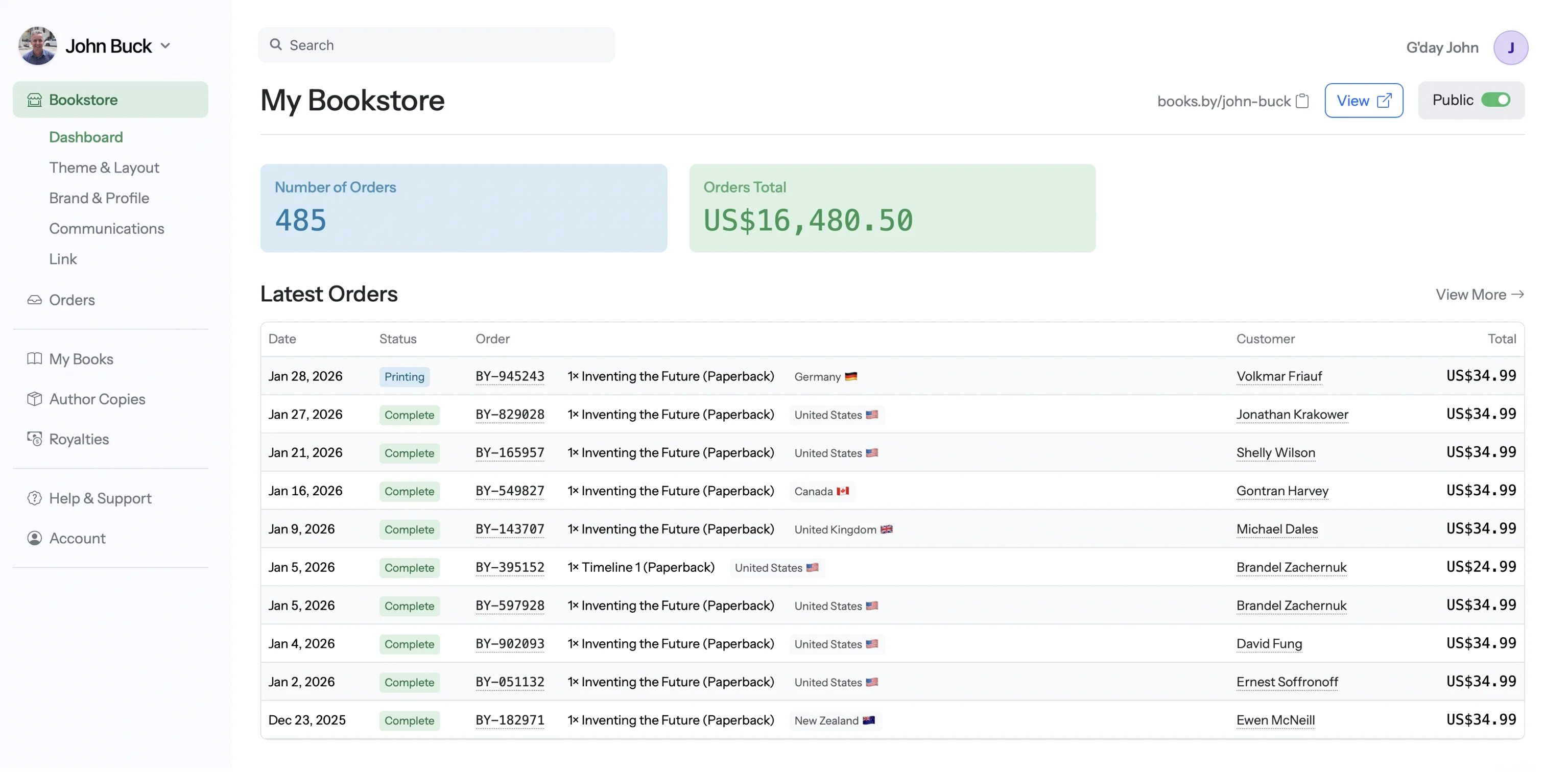
Books.by flips this model. Instead of distributing to retailers, you become the retailer.
The verdict: Books.by fills a gap D2D doesn't address: selling directly to readers you've attracted yourself. Use distribution platforms for organic discovery; use Books.by for traffic you generate. Keep 100% on the sales you drive.
If you like what D2D does but don't love giving up 10% of royalties, PublishDrive offers similar wide distribution with a flat subscription model.
The verdict: If you're selling enough ebooks that D2D's 10% exceeds $99/year (about 285 ebooks at $3.50 royalty), PublishDrive becomes the better deal. For low-volume authors, D2D's free model is still more economical.
Lulu is the low-stakes option. Free to use, reasonable distribution, straightforward interface. Not excellent at anything, but good enough for authors who want simplicity.
The verdict: Lulu is best for authors who want one simple platform for occasional print + ebook sales without maximizing any particular channel.
D2D alternatives aren't about replacing D2D — they're about filling gaps D2D can't cover. Here's how the pieces fit together:
1. Amazon KDP — Kindle ebooks + Amazon print sales. Non-negotiable for marketplace reach.
2. Draft2Digital — Wide ebook distribution to Apple, Kobo, B&N, libraries. Best-in-class for this job.
3. IngramSpark — Bookstore and library print distribution. Add only if physical retail matters to you.
4. Books.by — Direct print sales for your own traffic. 100% royalties on readers you bring.
This sounds like a lot of platforms. It is. But each serves a distinct purpose:
You don't need all four. But understanding what each does helps you choose the right tools for your specific goals.
D2D excels at ebook distribution but is limited for print (D2D Print is newer and less established). Authors also look elsewhere because D2D takes 10% of net royalties and doesn't offer direct-to-reader sales options.
Amazon KDP for Amazon sales (most online book sales happen there) and IngramSpark for bookstore/library distribution. Both have more mature print-on-demand infrastructure than D2D Print.
Yes, this is the standard approach. Use KDP for Kindle ebooks and Amazon print sales. Use D2D for Apple Books, Kobo, B&N, and other ebook retailers. This covers the entire market.
Yes, D2D takes 10% of net royalties on ebook sales. On a $4.99 ebook with a 70% royalty rate, you'd earn ~$3.14 through D2D vs $3.49 going direct to the retailer. That's about 10% off your net — modest per sale but meaningful at volume.
No. KDP Print is more established, offers Amazon Prime eligibility, and has better visibility in search results. D2D Print is functional but can't match KDP's marketplace advantages for Amazon sales.
Draft2Digital acquired Smashwords in 2022. Smashwords authors were migrated to D2D's platform. The Smashwords storefront still exists but D2D is now the primary platform for distribution.
Yes. Platforms like Books.by let you sell print books directly to readers with 100% royalties. D2D is a distribution platform (aggregator) — it sends your books to retailers. Direct sales platforms let you be the retailer.
Keep D2D for ebook distribution. Add Books.by for your own audience. Daily payouts, customer emails, and real royalties on print.
Start Your Bookstore →