Ash Davies
Founder of Books.by · Helped 50,000+ authors self-publish since 2014
Amazon KDP, IngramSpark, Lulu, Draft2Digital, Barnes & Noble Press, Kobo Writing Life, and Books.by. Here's an honest breakdown of every major platform — what each does well, where they fall short, and which is right for your book.
This table covers the key decision factors. Scroll down for detailed breakdowns of each platform.
| Platform | Type | Cost | Print Royalty* | Ebook Royalty | Payout | Best For |
|---|---|---|---|---|---|---|
| Amazon KDP | Marketplace | Free | $5.74 (29%) | 35-70% | 60 days | Amazon sales, ebooks |
| IngramSpark | Distributor | $49/title | $3.75 (19%) | 40-70% | 90 days | Bookstores, libraries |
| Books.by | Direct sales | $99/year | $9.60 (48%) | 100% | Daily | Your own traffic |
| Draft2Digital | Distributor | Free | Via partners | ~60% net | Monthly | Wide ebook distribution |
| Lulu | POD + Marketplace | Free | ~50-80% | 90% | Monthly | Specialty formats |
| B&N Press | Marketplace | Free | 55% | 45-65% | Monthly | B&N ecosystem |
| Kobo Writing Life | Marketplace | Free | N/A | 45-70% | 45 days | International ebooks |
*Print royalty based on $19.99, 200-page B&W paperback.
Before diving into individual platforms, understand that they fall into three categories. This shapes everything about how they work and what you can expect.
Examples: Amazon KDP, Barnes & Noble Press, Kobo, Lulu
How it works: You publish on their store. They have the customers. You get a percentage of each sale.
Upside: Built-in traffic, no marketing required to get started.
Downside: You don't own the customer relationship. They take 30-65% of every sale.
Examples: IngramSpark, Draft2Digital
How it works: They make your book available to retailers (bookstores, Amazon, Apple, etc.) who then sell to customers.
Upside: Wide reach. Get into stores you couldn't access directly.
Downside: Multiple middlemen = lower royalties. You still don't own the customer.
Examples: Books.by, Shopify, Gumroad
How it works: You sell directly to readers through your own storefront. No middleman retailer.
Upside: Highest royalties. You own the customer relationship. Fast payouts.
Downside: You have to bring your own traffic. No discovery from the platform itself.
Most successful indie authors use a combination — typically a marketplace for discovery, a distributor for reach, and direct sales for their owned audience. Let's look at each platform specifically.
The 800-pound gorilla. Where most books sell.
Amazon dominates book sales. Period. If you're only going to use one platform, this is it. KDP gives you access to the world's largest book marketplace with hundreds of millions of active shoppers. Their recommendation engine can surface your book to readers who've never heard of you. Kindle Unlimited (via KDP Select) offers additional reach for ebooks.
The gateway to bookstores and libraries.
IngramSpark is owned by Ingram, the company that supplies books to most bookstores in the world. Publishing through IngramSpark makes your book orderable through their catalog — which is what bookstores and libraries use. It's not about selling books through IngramSpark directly; it's about access.
Your own bookstore. 100% royalties.
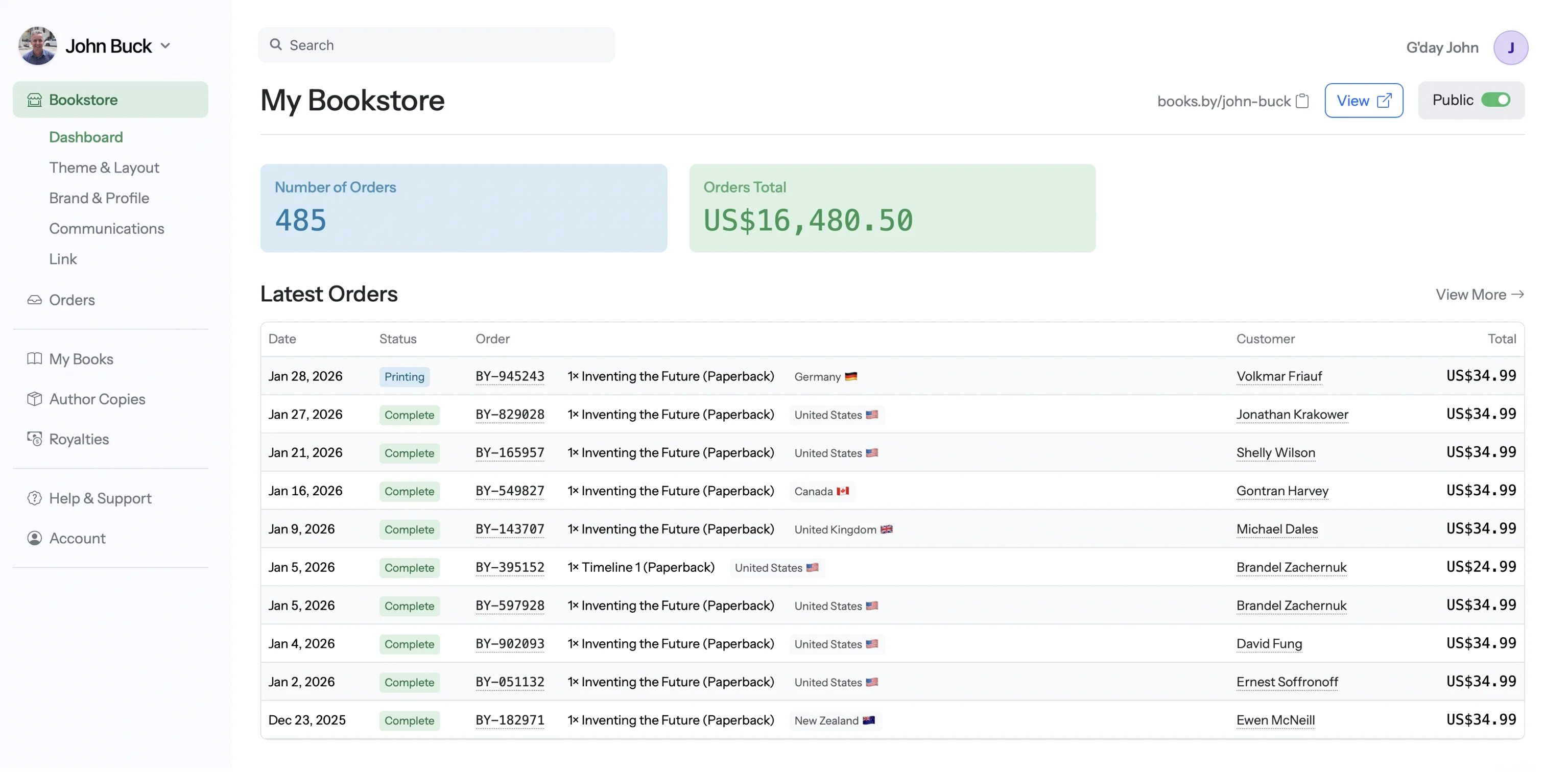
Books.by is different from every platform above. It's not a marketplace or distributor — it's your own direct-to-reader storefront with built-in print-on-demand. You keep 100% of royalties, get customer email addresses with every sale, and receive daily payouts. The tradeoff: you bring your own traffic.
Wide ebook distribution made easy.
D2D is the easiest way to distribute ebooks to multiple retailers (Apple Books, Kobo, Barnes & Noble, etc.) from one dashboard. They take 10% of what you earn after the retailer's cut. Their print distribution uses IngramSpark under the hood. Author-friendly with great tools like Universal Book Links.
Specialty printing and niche formats.
Lulu is one of the original POD platforms. They offer unique formats (spiral binding, calendars, photo books) that other platforms don't. Their global distribution network includes Amazon and other retailers. Good for specialty projects but less competitive for standard trade books.
Direct access to B&N's ecosystem.
B&N Press (formerly Nook Press) gives you direct access to Barnes & Noble's online and physical stores. Print books can be ordered through B&N stores and their website. The Nook ebook store is small compared to Kindle, but it's free and adds another sales channel.
Strong international ebook presence.
Kobo is particularly strong in Canada, Australia, UK, and international markets where Amazon is less dominant. Kobo Plus (their subscription service) offers authors additional reach. Ebook-only platform — no print option through Kobo directly.
Start with: Amazon KDP only. Learn the process, see if anyone buys. Add IngramSpark and direct sales later once you have traction.
Use: KDP for Amazon + Books.by for direct sales. Send your own traffic to Books.by (keep 100%), let Amazon handle organic discovery.
Use: IngramSpark (so event venues can order) + Books.by (back-of-room sales with 100% margin + lead capture). Amazon optional.
Use: KDP for Amazon + Draft2Digital for other ebook retailers + IngramSpark for bookstore/library print access.
Use: Lulu for specialty formats (spiral, calendar) + IngramSpark for standard trade distribution.
Use: Books.by for all traffic you control. Accept lower-royalty platforms (KDP, IngramSpark) only for traffic you don't control.
Amazon KDP is the best starting point for beginners. It's completely free, has a simple interface, and gives you access to the world's largest book marketplace. You can publish both ebooks and paperbacks with no upfront costs.
Direct sales platforms like Books.by pay the highest effective royalties — 100% of the retail price minus only print and payment processing costs. For traditional platforms, KDP offers 70% on ebooks (with restrictions) and 60% on print (minus print costs).
Yes, and most successful authors do. A common strategy is using KDP for Amazon, IngramSpark for bookstore/library distribution, Draft2Digital for wide ebook distribution, and Books.by for direct sales. Just avoid duplicate distribution to the same retailer.
A marketplace (Amazon KDP) sells books on its own website with built-in traffic. A distributor (IngramSpark, D2D) sends your book to other retailers who sell it. A direct sales platform (Books.by) lets you sell directly to readers through your own storefront.
It depends on the platform and your goals. Amazon uses ASINs and provides free KDP-imprinted ISBNs. IngramSpark requires your own ISBN. For professional credibility and bookstore distribution, having your own ISBN is recommended. Books.by provides free ISBNs with no restrictions.
IngramSpark is the gold standard for bookstore and library distribution. Bookstores order through Ingram's catalog, and IngramSpark makes your book available there. You'll need to set a competitive wholesale discount (typically 55%) and enable returns.
Amazon KDP now offers hardcover printing. IngramSpark and Lulu have offered hardcovers for years. For print-on-demand hardcovers, KDP and IngramSpark are the main options.
Payout timing varies significantly: Amazon KDP pays 60 days after month-end, IngramSpark pays 90 days, Lulu pays monthly, Draft2Digital pays monthly. Direct sales platforms like Books.by pay daily, which is a significant cash flow advantage.
Add Books.by to your platform mix. Use KDP for Amazon discovery, but send YOUR traffic (email list, social, website) to your own store. 100% royalties. Daily payouts.
Start Your Bookstore →