Ash Davies
Founder of Books.by · Helped 50,000+ authors self-publish since 2014
Amazon's marketplace dominance vs D2D's wide distribution elegance. These platforms serve different purposes — and most successful authors use both. Here's how to think about them strategically.
| Feature | Amazon KDP | Draft2Digital | Books.by |
|---|---|---|---|
| Platform Type | Marketplace (Amazon) | Aggregator (distributes to retailers) | Direct-to-reader storefront |
| Cost | Free | Free (10% of net) | $99/year |
| Ebook Distribution | Kindle only | Apple, Kobo, B&N, libraries, 20+ retailers | Coming 2026 |
| Print Distribution | Amazon only | Via Ingram (Amazon + retailers) | Direct sales only |
| Ebook Royalty* | 70% ($2.99-$9.99) | 63% (70% × 90%) | 100% (coming) |
| Print Royalty* | $5.74 | ~$5.00 | $9.60 |
| Kindle Unlimited | ✓ (exclusive) | ✗ | ✗ |
| Free Formatting | ✗ | ✓ | ✗ |
| User Experience | Functional but dated | Excellent | Modern |
| Customer Data | ✗ | ✗ | ✓ |
| Payouts | 60 days | ~60 days | Daily |
| Best For | Amazon marketplace sales | Wide ebook distribution | Direct sales, own traffic |
*Ebook royalty on $4.99 book. Print royalty on 200-page B&W at $19.99. D2D's 10% is on net (after retailer cut).
This comparison is weird because KDP and D2D aren't really competitors. They serve different functions and most authors use both simultaneously.
Amazon KDP is a marketplace. It's a store where readers buy books. When you publish through KDP, your book appears on Amazon.com where 300+ million customers can find it. Amazon does the marketing (recommendations, search, ads), handles payment, ships the product. You get access to the world's largest book retailer.
Draft2Digital is an aggregator. It takes your book and distributes it to multiple stores: Apple Books, Kobo, Barnes & Noble, libraries, and more. D2D isn't a store — it's a logistics service that saves you from uploading separately to each retailer.
Here's the thing: D2D doesn't distribute to Amazon. The biggest ebook retailer in the world isn't in D2D's network. This isn't a limitation — Amazon's size means they demand direct relationships with publishers. So if you want to reach Kindle readers, you need KDP. Period.
This is why the "KDP vs D2D" framing is misleading. It's not either/or. It's KDP + D2D for most authors going wide.
For ebooks, KDP and D2D serve completely different markets:
Reaches: Kindle (Amazon)
Market share: ~70% of US ebook sales
Royalty rates:
Kindle Unlimited: Available (requires exclusivity)
Reaches: Apple Books, Kobo, B&N, libraries, 20+ stores
Market share: ~30% of US ebook sales (combined)
Royalty rates:
D2D keeps 10% of net royalties
The royalty math: On a $4.99 ebook, KDP pays you $3.49 (70%). Through D2D to Apple, you'd get $3.14 (70% from Apple, minus D2D's 10%). The difference is $0.35 per book — not huge, but D2D's value is convenience, not maximum royalties.
Could you go direct? Yes. You can publish directly to Apple Books, Kobo, and B&N without D2D. You'd keep that extra 10%. But you'd also manage three separate dashboards, three upload processes, three reporting systems. D2D's 10% is the price of consolidation.
Here's where KDP and D2D actually compete: the exclusivity question.
KDP Select is Amazon's exclusivity program. Enroll your ebook and you get:
The catch: Your ebook can ONLY be sold on Amazon for 90 days. No Apple, no Kobo, no D2D distribution. Auto-renews unless you opt out.
There's no universally right answer. Some genres (romance, urban fantasy) genuinely perform better in KDP Select. Others (literary fiction, memoir, business books) do fine going wide. The only way to know for your books is to test.
Both platforms now offer print-on-demand. Here's how they compare:
The honest take: For Amazon print sales, KDP Print is significantly better. Books get Prime eligibility, better search placement, and the "Buy Now" button. D2D Print books sold on Amazon are treated as third-party inventory — worse placement, no Prime.
D2D Print's advantage is reaching bookstores and retailers outside Amazon via Ingram distribution. But for that, you might as well use IngramSpark directly.
Practical recommendation: Use KDP Print for Amazon, IngramSpark for wide print distribution. D2D Print is convenient but compromises on both.
One area where D2D unambiguously beats KDP: the user experience.
D2D's interface is genuinely good. Modern design, intuitive workflows, helpful formatting tools. You can upload a Word document and D2D will convert it to a properly formatted ebook. The dashboard is clean. Reporting is clear. It's pleasant to use.
KDP's interface is... functional. It works, but it's dated, cluttered, and occasionally confusing. Navigation is inconsistent. Some features are buried. It feels like software designed by engineers who've never watched a real user try to use it.
This matters if you're publishing frequently or managing multiple titles. KDP's friction adds up over time. D2D respects your time.
D2D's formatting tools are a genuine advantage. Upload your manuscript as a Word doc, and D2D can generate properly formatted ebooks and print-ready PDFs. Free. This alone can save you $50–200 per book if you'd otherwise pay a formatter.
KDP and D2D are both distribution platforms. They send your books to stores. What neither offers is a way to sell directly to your readers.
When you sell through Amazon (via KDP) or Apple/Kobo (via D2D), you never learn who bought your book. No email address, no name, no way to reach them when your next book comes out. They're Amazon's customers or Apple's customers — not yours.
This is fine for organic discovery. Readers browsing Amazon or Apple don't expect a relationship with the author. But when YOU bring the reader — through your email list, social media, podcast, speaking events — sending them to Amazon means giving 30–40% of the sale to a middleman who doesn't give you their contact info.
This is where direct sales platforms like Books.by come in.
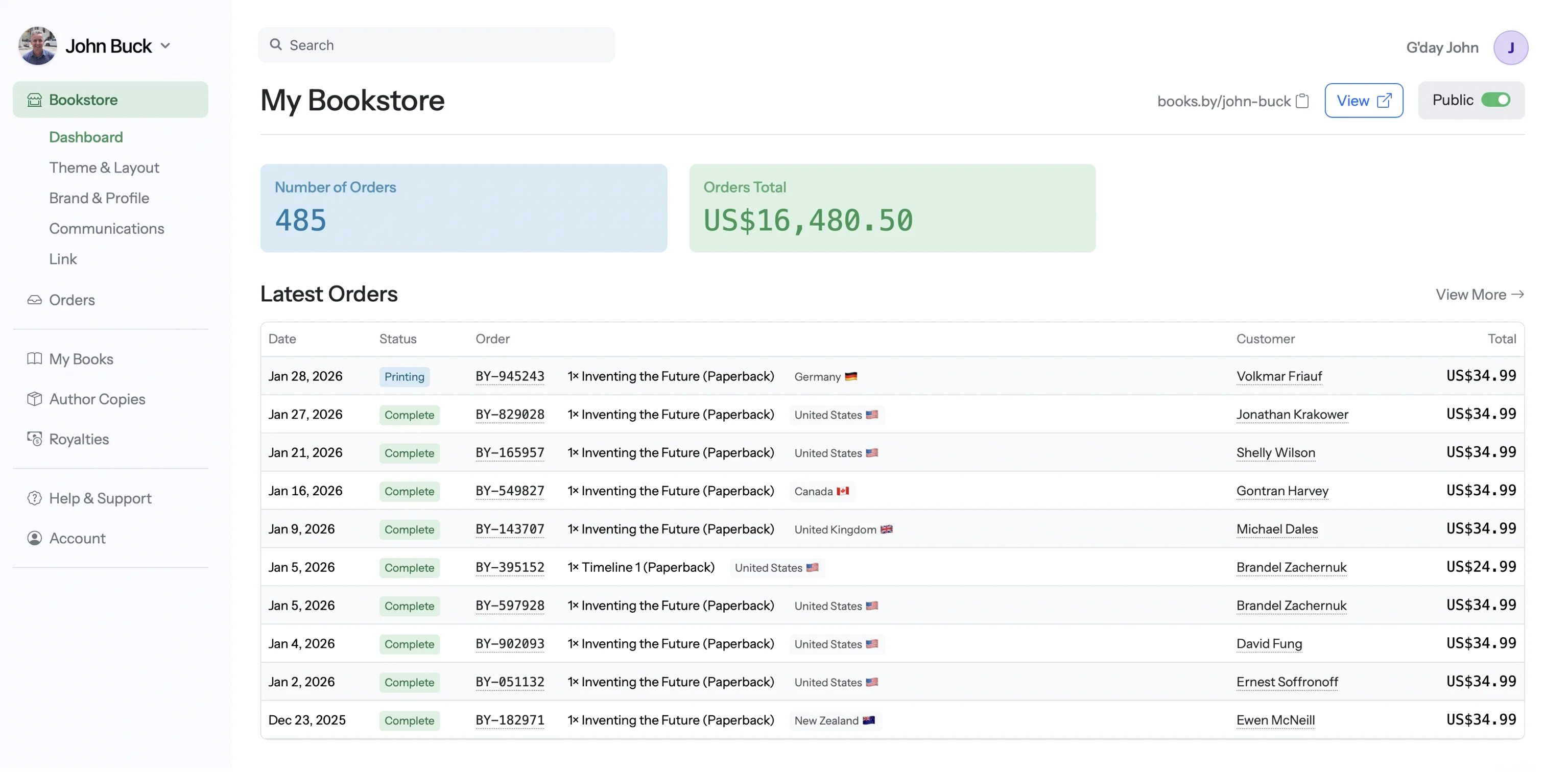
When you send your own traffic to your own storefront, you keep 100% of royalties, get paid daily, and capture customer emails for future marketing. Use KDP and D2D for discovery. Use Books.by for your own audience. Keep what you earn.
Use KDP for Amazon — ebooks (with or without KDP Select) and print. Use D2D for everywhere else — Apple, Kobo, B&N, libraries. This combination covers 95%+ of the ebook market and the largest print retailer. Add IngramSpark for bookstore distribution and Books.by for direct sales, and you've built a complete publishing infrastructure.
If you're just starting: Start with KDP. It's where the sales are. Add D2D when you want to go wide or if KDP Select isn't working for your genre.
If you're in a KU-heavy genre: Test KDP Select first. If page reads are strong, stay exclusive. If not, go wide with D2D.
If you value independence: Go wide from day one. KDP + D2D. No exclusivity, no dependency on one retailer's algorithm.
Most authors use both. KDP for Kindle (which D2D doesn't distribute to) and D2D for Apple Books, Kobo, B&N, and libraries. Together they cover the entire ebook market.
No. D2D distributes to Apple Books, Kobo, Barnes & Noble, libraries, and many other retailers, but not Amazon Kindle. You need to publish directly through KDP to reach Kindle readers.
KDP offers 70% royalty on books priced $2.99–$9.99 (35% outside that range). D2D takes 10% of whatever the retailer pays you, so you get 63% on Apple (which pays 70%) or 54% on B&N (which pays 60%).
For Amazon sales, yes. KDP Print offers Prime eligibility, better search placement, and direct integration. D2D Print distributes through Ingram, which works but doesn't get the same Amazon marketplace advantages.
KDP Select is Amazon's exclusivity program — your ebook can only be sold on Amazon for 90 days. In exchange, you get Kindle Unlimited page reads and promotional tools. It works well for some genres (romance, thrillers) but locks you out of D2D and other retailers.
Draft2Digital has a significantly better user experience. The interface is modern, intuitive, and includes free formatting tools. KDP is functional but dated and clunkier to navigate.
Yes, but you must wait for your current 90-day enrollment period to end and opt out of auto-renewal. Then you can publish on D2D and other retailers. Some authors find KDP Select page reads hard to give up.
Use KDP and D2D for discovery. Use Books.by for direct sales. Keep what you earn, get paid daily, own your customer relationships.
Start Your Bookstore →