Ash Davies
Founder of Books.by · Helped 50,000+ authors self-publish since 2014
Print distribution powerhouse meets ebook aggregator champion. These platforms have different strengths, and most wide authors use both. Here's how they compare and when to use each.
| Feature | IngramSpark | Draft2Digital | Books.by |
|---|---|---|---|
| Primary Strength | Print distribution | Ebook aggregation | Direct sales |
| Cost | $49/title (often waived) | Free (10% of net) | $99/year |
| Print Distribution | 40,000+ retailers | Via Ingram | Direct only |
| Ebook Distribution | Apple, B&N, Kobo, Google | Apple, Kobo, B&N, libraries, 20+ | Coming 2026 |
| Bookstore Access | Excellent | Limited | N/A |
| Library Distribution | ✓ | ✓ (ebooks) | ✗ |
| Returnability | ✓ | ✗ | Author controls |
| Free Formatting | ✗ | ✓ | ✗ |
| User Experience | Complex | Excellent | Modern |
| Customer Support | Formal/slower | Responsive | Fast |
| Payout Speed | 90 days | ~60 days | Daily |
| Customer Data | ✗ | ✗ | ✓ |
| Best For | Bookstore/library print | Wide ebook distribution | Direct sales, your traffic |
D2D's 10% is on net royalties after retailer cuts, not gross.
IngramSpark and Draft2Digital evolved from opposite directions. Understanding this helps you use them strategically.
IngramSpark is Ingram's self-publishing arm. Ingram Content Group is the backbone of book distribution — they supply books to bookstores, libraries, and retailers worldwide. When you use IngramSpark, you're plugging directly into the same distribution network that major publishers use. Print is their core competency. Ebooks are an add-on.
Draft2Digital started as an ebook aggregator. Their mission was to make wide ebook distribution painless. Upload once, distribute to Apple, Kobo, Barnes & Noble, libraries, and others. Print came later (D2D Print) and routes through Ingram anyway. Ebooks are their core competency. Print is an add-on.
This means comparing them head-to-head is slightly misleading. They're each excellent at different things:
For print books, IngramSpark is the clear choice. Here's why:
The returnability issue is crucial. Most bookstores won't stock books they can't return if they don't sell. IngramSpark lets you enable returns (accepting the risk). D2D Print doesn't offer this. For bookstore placement, this matters.
D2D Print's advantage is simplicity. No $49 setup fee, easier interface, works fine for authors who just want print books available without optimizing for bookstore placement.
The honest recommendation: If bookstores and libraries matter to you, use IngramSpark for print. If you just want print-on-demand availability and aren't targeting physical retail, D2D Print (or KDP Print) is simpler.
For ebook distribution, the situation reverses. D2D is purpose-built for this:
D2D's formatting tools are huge. Upload a Word document, and D2D converts it to properly formatted EPUB. This saves $50–150 vs hiring a formatter. IngramSpark requires print-ready files — no hand-holding.
D2D's library distribution is excellent. They work with OverDrive, hoopla, and other library platforms for ebook lending. IngramSpark does print library distribution better, but D2D does ebook library distribution better.
If you use both platforms, you'll need to avoid conflicts. Both can distribute to the same retailers — selling the same book through two channels creates problems.
The key is assigning each channel to one platform:
This combination gives you comprehensive coverage without conflict. Yes, it's three platforms. Welcome to wide publishing.
For wide authors: KDP for Amazon (print + Kindle). IngramSpark for bookstore/library print distribution. D2D for wide ebook distribution. Books.by for direct sales where you keep 100%. This is the full infrastructure.
IngramSpark and D2D are both distribution platforms. They put your books in stores. What neither offers is the ability to sell directly to your readers.
When you sell through Barnes & Noble (via D2D) or an indie bookstore (via IngramSpark), you don't know who bought your book. No email address, no customer relationship. They're the retailer's customers.
This is fine for organic discovery — random readers finding your book while browsing. But when you've built an audience through your email list, podcast, speaking, or social media, sending them to a retailer means giving up 30–55% of the sale to intermediaries.
This is where direct sales come in.
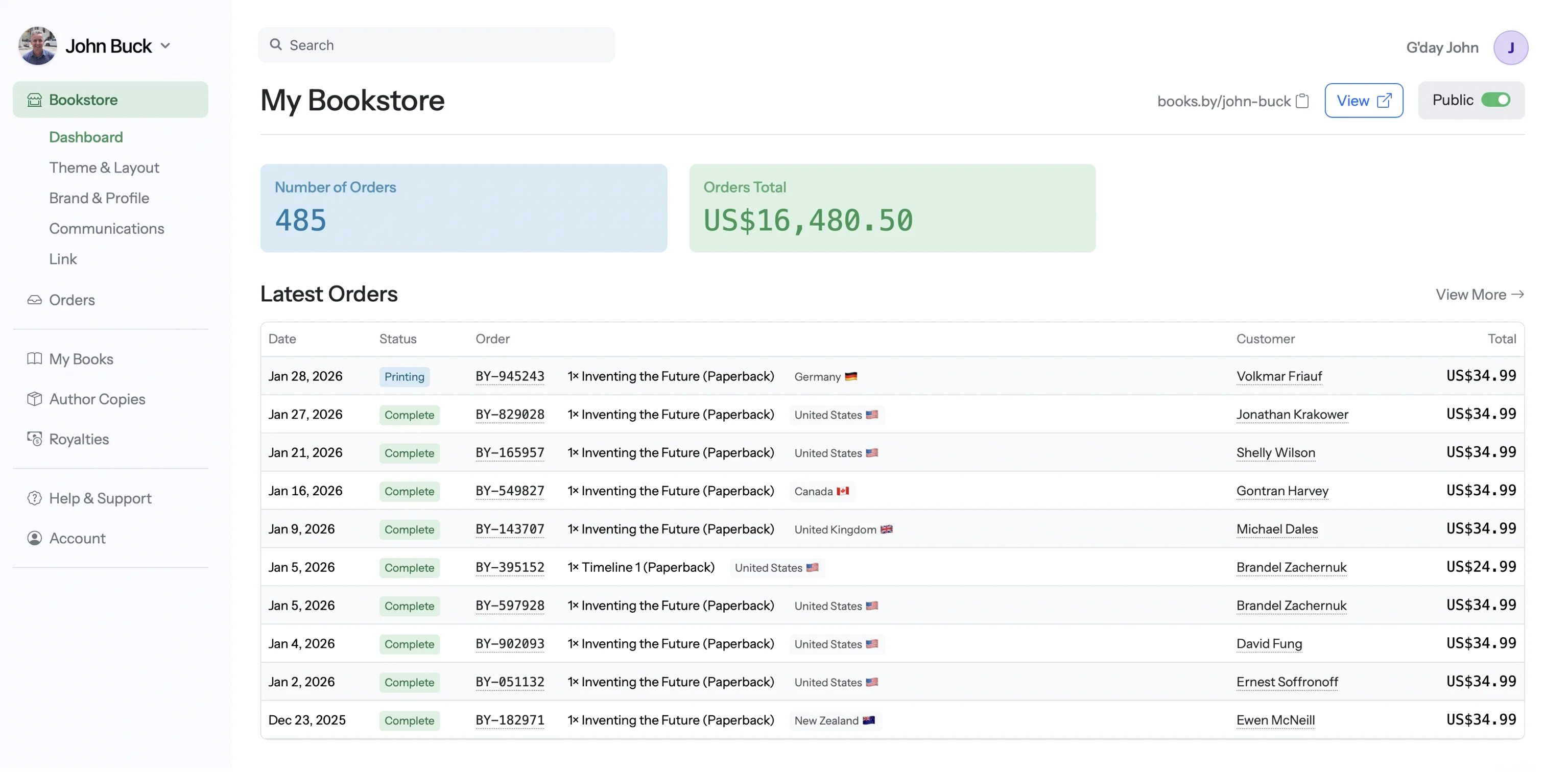
Platforms like Books.by let you sell directly to readers. You keep 100% of royalties (minus print/processing) — that's $9.60 on a $19.99 paperback vs $3.75 through IngramSpark's wholesale model. You get paid daily and capture customer emails. Use IngramSpark and D2D for distribution. Use Books.by for your own traffic. Keep what you earn on the audience you've built.
They serve different purposes. IngramSpark excels at print distribution to bookstores and libraries. Draft2Digital excels at ebook distribution to Apple, Kobo, B&N, and libraries. Most authors going wide use both.
D2D Print distributes through Ingram, which makes books available to bookstores, but it's not as well-integrated as going direct through IngramSpark. D2D Print doesn't offer returnability, which many bookstores require.
IngramSpark offers ebook distribution, but it's not their focus. Draft2Digital has better ebook integration, a superior interface, and free formatting tools. For ebooks, D2D is the stronger choice.
D2D is free to use (takes 10% of net). IngramSpark charges $49 per title setup (often waived with promo codes). For high-volume authors, IngramSpark can be cheaper; for casual authors, D2D's free model wins.
Yes, and many authors do. Use IngramSpark for print distribution to bookstores/libraries, and D2D for ebook distribution to Apple, Kobo, B&N. Just be careful about overlapping distribution channels.
Not fully. D2D Print routes through Ingram anyway, but lacks features like returnability, detailed distribution control, and library-specific programs. For serious print distribution, IngramSpark is still preferred.
Draft2Digital is known for excellent, responsive support. IngramSpark support is functional but slower and more formal. D2D's author-friendly reputation extends to their support team.
Use IngramSpark and D2D for distribution. Use Books.by for your own traffic. Daily payouts, customer emails, and real royalties.
Start Your Bookstore →