Ash Davies
Founder of Books.by · Helped 50,000+ authors self-publish since 2014
IngramSpark has the distribution reach, but the fees, complexity, and 90-day payouts frustrate a lot of authors. Here are 5 alternatives — with honest assessments of what you gain and lose by switching.
IngramSpark is the gold standard for getting books into physical bookstores and libraries. But that doesn't mean it's right for everyone — or easy to use. Here's what drives authors to look elsewhere:
The fees add up. $49 per title setup. $25 to make changes. Need to fix a typo? That's $25. Update your price? $25. Every revision costs money.
The interface is hostile. File requirements are strict and poorly documented. Spine width calculations are confusing. Many first-time users get rejected files repeatedly. The learning curve is real.
90-day payouts are brutal. Sell a book in January, get paid in April. That's cash flow you could be using for marketing, ads, or your next book sitting in IngramSpark's pocket for three months.
The wholesale discount eats your margin. To get into bookstores, you need a 55% discount. After that and print costs, you might keep $2-4 per book. On a $19.99 book, that's painful.
You need your own ISBN. IngramSpark doesn't provide them. That's $125 for one ISBN, or $295 for ten (in the US). Add that to your setup costs.
The question is: do you actually need IngramSpark's distribution? If bookstores and libraries aren't crucial to your strategy, you might not.
| Platform | Cost | Bookstore Distro | Library Access | Payout | Best For |
|---|---|---|---|---|---|
| IngramSpark | $49/title | ✅ Excellent | ✅ Yes | 90 days | Wide distribution |
| Amazon KDP | Free | ❌ None | ❌ No | 60 days | Amazon sales |
| Books.by | $99/year | ❌ None (direct sales) | ❌ No | Daily | Direct sales |
| Lulu | Free | ⚠️ Limited | ❌ Limited | Monthly | Specialty formats |
| Draft2Digital | Free | ⚠️ Via IngramSpark | ⚠️ Via IS | Monthly | Easy distribution |
| B&N Press | Free | ⚠️ B&N only | ❌ No | Monthly | B&N-specific |
Note: Several "alternatives" use IngramSpark under the hood for distribution. You're getting IS distribution with different interfaces/pricing.
Here's what nobody wants to say: there is no direct replacement for IngramSpark's distribution reach.
IngramSpark is owned by Ingram, the largest book wholesaler in the world. Bookstores and libraries order from Ingram's catalog. If you want your book easily orderable at Barnes & Noble, indie bookstores, and libraries across the world, IngramSpark is how you get there.
The "alternatives" below solve different problems:
The question isn't "what replaces IngramSpark?" It's "do I actually need what IngramSpark offers?" Many authors don't. If your sales are primarily online and you're not doing bookstore events, you might be paying for distribution you don't use.
The most popular IngramSpark alternative
Most authors who "leave" IngramSpark go to KDP. It's free, simple, and gets you on the world's largest book retailer. No per-title fees. No revision fees. Faster payouts (60 days vs 90). Higher per-book royalties because there's no wholesale discount.
What you lose: Bookstore distribution. Library access. Returns (bookstores won't stock non-returnable books). The ability to get your book into Barnes & Noble, indie stores, or your local library. If these matter to you, KDP alone isn't enough.
Best strategy: Use KDP for Amazon sales AND IngramSpark for bookstore distribution. Disable IngramSpark's Amazon channel to avoid conflicts. This gives you the best of both worlds, though you're still paying IngramSpark's fees.
Skip distribution entirely — sell direct
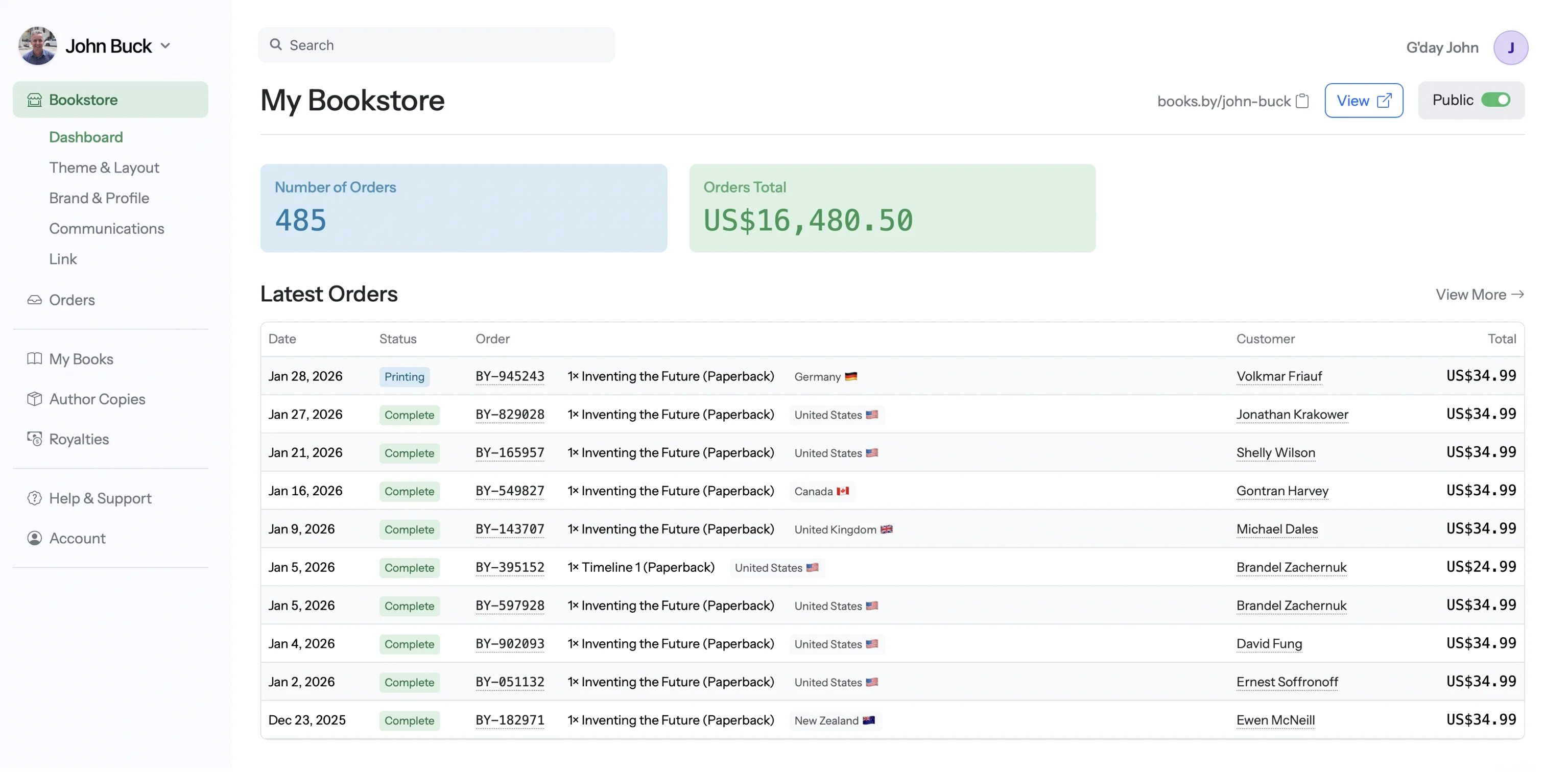
Books.by takes a completely different approach. Instead of distributing to retailers, you sell directly to readers through your own storefront. Print-on-demand built in. 100% royalties. Daily payouts. Customer email addresses with every sale.
What you lose: All distribution. No bookstores, no libraries, no retailers at all. You bring your own traffic. This isn't a replacement for IngramSpark's distribution — it's for sales you generate yourself.
Best for: Authors with their own audience (email list, social media, podcast, speaking). If IngramSpark's bookstore sales are minimal and most of your sales come from your own marketing, why give retailers a cut? On a $19.99 paperback: IngramSpark retailer sale = ~$3.75 royalty. Books.by direct sale = ~$9.60 royalty.
Simpler interface, specialty formats
Lulu is one of the original POD platforms (since 2002). No setup fees, easier file requirements, and unique format options like spiral binding, calendars, and photo books. Their global distribution network includes Amazon and some other retailers.
What you lose: Lulu's distribution is weaker than IngramSpark's. Bookstores don't order from Lulu's catalog the way they order from Ingram. Print quality and paper options are more limited. Returns aren't as flexible.
Best for: Authors who want a simpler experience, specialty formats (cookbooks, photo books, workbooks), or bulk author copies. Not a full replacement for IngramSpark's distribution reach.
Easier interface, but still uses IngramSpark
D2D's print offering uses IngramSpark under the hood, but with a much friendlier interface. No title fees. No revision fees. You're getting IngramSpark's distribution through D2D's easier platform.
What you lose: Some IngramSpark-specific options (certain paper types, hardcover options). D2D adds their fee on top, so royalties are slightly lower. You're adding a middleman.
Best for: Authors who want IngramSpark's distribution without IngramSpark's interface. Trade the per-title fees for a slightly lower royalty rate and much better user experience.
Direct to B&N, but limited reach
B&N Press gives you direct access to Barnes & Noble's website and stores. Your book can be made available for in-store ordering. No fees, decent royalty rate, monthly payouts.
What you lose: Everything except Barnes & Noble. No indie bookstores, no libraries, no international distribution, no Amazon. B&N is just one retailer — you'd still need other platforms.
Best for: Adding B&N as one part of a multi-platform strategy. Not a standalone replacement for IngramSpark's distribution reach.
Yes → You probably need IngramSpark (or D2D, whose print uses IS). There's no true alternative for wide physical distribution.
No → Use KDP for Amazon + Books.by for direct sales. Skip IngramSpark entirely.
Yes → Try Draft2Digital Print. Same IngramSpark distribution, much friendlier interface, no per-title fees.
No → Your issue is probably fees or payouts. Consider whether you're actually using the distribution you're paying for.
Mostly Amazon → Focus on KDP. IngramSpark might not be adding value for you.
Mostly your own marketing → Consider Books.by for direct sales. Why give retailers 55% on sales you generated?
Bookstores/libraries → You need IngramSpark. No real alternative exists.
Yes → Prioritize platforms with faster payouts: Books.by (daily), Lulu (monthly), D2D (monthly). IngramSpark's 90 days is rough for cash-strapped authors.
No → Payout timing matters less than distribution reach and royalty rates.
Most successful indie authors use multiple platforms strategically:
KDP for Amazon (biggest online retailer)
IngramSpark for bookstores/libraries (only if needed)
Books.by for direct sales (highest royalties on your own traffic)
The goal isn't to find one platform that does everything. It's to use each platform for what it does best.
Amazon KDP is the best free alternative for print-on-demand publishing. It has no setup fees, no title fees, and no minimum sales. However, it only sells on Amazon — you lose IngramSpark's bookstore and library distribution.
Limited options exist. Draft2Digital's print service uses IngramSpark under the hood. Some bookstores order from Amazon. Barnes & Noble Press gives you B&N specifically. But for wide bookstore/library distribution, IngramSpark remains the standard — there's no full equivalent.
IngramSpark pays 90 days after the sale because they're a distributor, not a retailer. They're waiting on payments from the retailers who actually sold your book. It's frustrating but industry-standard for wholesale distribution.
Lulu is simpler and free, making it easier for beginners. However, IngramSpark has better distribution reach, more paper options, and is the industry standard for bookstores. Lulu is better for specialty formats and author copies; IngramSpark is better for professional distribution.
Not necessarily. If you only sell online and don't need bookstore or library access, KDP alone may be sufficient. Add IngramSpark if you do speaking events, want library distribution, or need books available at physical bookstores.
For selling: Amazon KDP (free, no fees, just royalty split). For author copies: Lulu often has competitive pricing. For highest royalties per sale: direct sales through Books.by (100% royalties but $99/year subscription).
Books.by pays daily. 100% royalties on direct sales. Keep using IngramSpark for bookstores, but send your own traffic to your own store.
Start Your Bookstore →