Ash Davies
Founder of Books.by · Helped 50,000+ authors self-publish since 2014
Tired of KDP Select exclusivity? Want better royalties, faster payouts, or customer data? Here are 7 legitimate alternatives to Amazon KDP — with honest assessments of what each does well (and where they fall short).
Let's be honest: Amazon dominates book sales. About 50% of all ebook sales and a significant portion of print sales happen on Amazon. So why would anyone want an alternative?
KDP Select — the program that gets you into Kindle Unlimited — requires 90-day exclusivity. You can't sell that ebook anywhere else. Not Apple. Not Kobo. Not on your own website. For some authors, the Kindle Unlimited page reads are worth it. For others, it's leaving money on the table.
KDP takes 30-65% of your ebook revenue (depending on price and territory). For print books, they take 40% plus print costs. On a $19.99 paperback, you might keep only $5-6. That's fine for organic Amazon traffic. But when YOU generate the sale through your own marketing, you're paying Amazon for... what exactly?
Sell a thousand books on Amazon. Know exactly zero of your customers. Can't email them about your next book. Can't build a relationship. Can't even thank them. Amazon owns that relationship. You're just the supplier.
Sell a book January 15th. Get paid March 30th (60 days after month-end). That's cash flow Amazon gets to use for 75 days before you see a dime.
None of this means you should leave Amazon. For most authors, Amazon should remain part of the strategy — it's just too big to ignore. The question is whether it should be your ONLY platform, and whether you should lock yourself into KDP Select exclusivity.
| Platform | Best For | Cost | Royalties | Payout | Customer Data |
|---|---|---|---|---|---|
| IngramSpark | Bookstores & libraries | $49/title | Varies (low after discount) | 90 days | ❌ No |
| Draft2Digital | Wide ebook distribution | Free | ~60% net | Monthly | ❌ No |
| Books.by | Direct sales, own traffic | $99/year | 100% | Daily | ✅ Full |
| Lulu | Specialty formats | Free | 50-80% | Monthly | ❌ Limited |
| B&N Press | Barnes & Noble ecosystem | Free | 45-65% | Monthly | ❌ No |
| Kobo Writing Life | International ebooks | Free | 45-70% | 45 days | ❌ No |
| Apple Books | Apple device users | Free | 70% | Monthly | ❌ No |
The bookstore and library gateway
IngramSpark is owned by Ingram, the largest book distributor in the world. Publishing through them makes your book available to 40,000+ retailers, libraries, and international distributors. If you want your book orderable at Barnes & Noble, indie bookstores, or libraries, this is how.
The catch: Bookstores need margin to resell your book, so you'll set a wholesale discount (typically 55%). After that discount and print costs, you might earn $2-4 per book sold through retailers. Much less than KDP's ~$5-6 per book on Amazon. IngramSpark is about access, not income maximization.
Best for: Authors who do speaking events, want library access, or need their book orderable at physical bookstores. Use alongside KDP (disable IngramSpark's Amazon distribution to avoid conflicts).
The "go wide" distribution hub
D2D makes "going wide" easy. One upload, and they distribute your ebook to Apple Books, Barnes & Noble, Kobo, libraries, and more. They take 10% on top of whatever the retailer takes. Their author tools are excellent — Universal Book Links, automated endmatter, formatting help.
The catch: That 10% adds up. If Apple pays 70%, you're getting about 63% after D2D's cut. You could go direct to each retailer for more, but D2D's convenience is worth it for many authors. Their print offering is just distribution through IngramSpark — not a separate printing option.
Best for: Ebook authors who want to be on multiple retailers without managing multiple dashboards. Especially popular with romance and genre fiction authors who want wide distribution.
Your own bookstore, 100% royalties
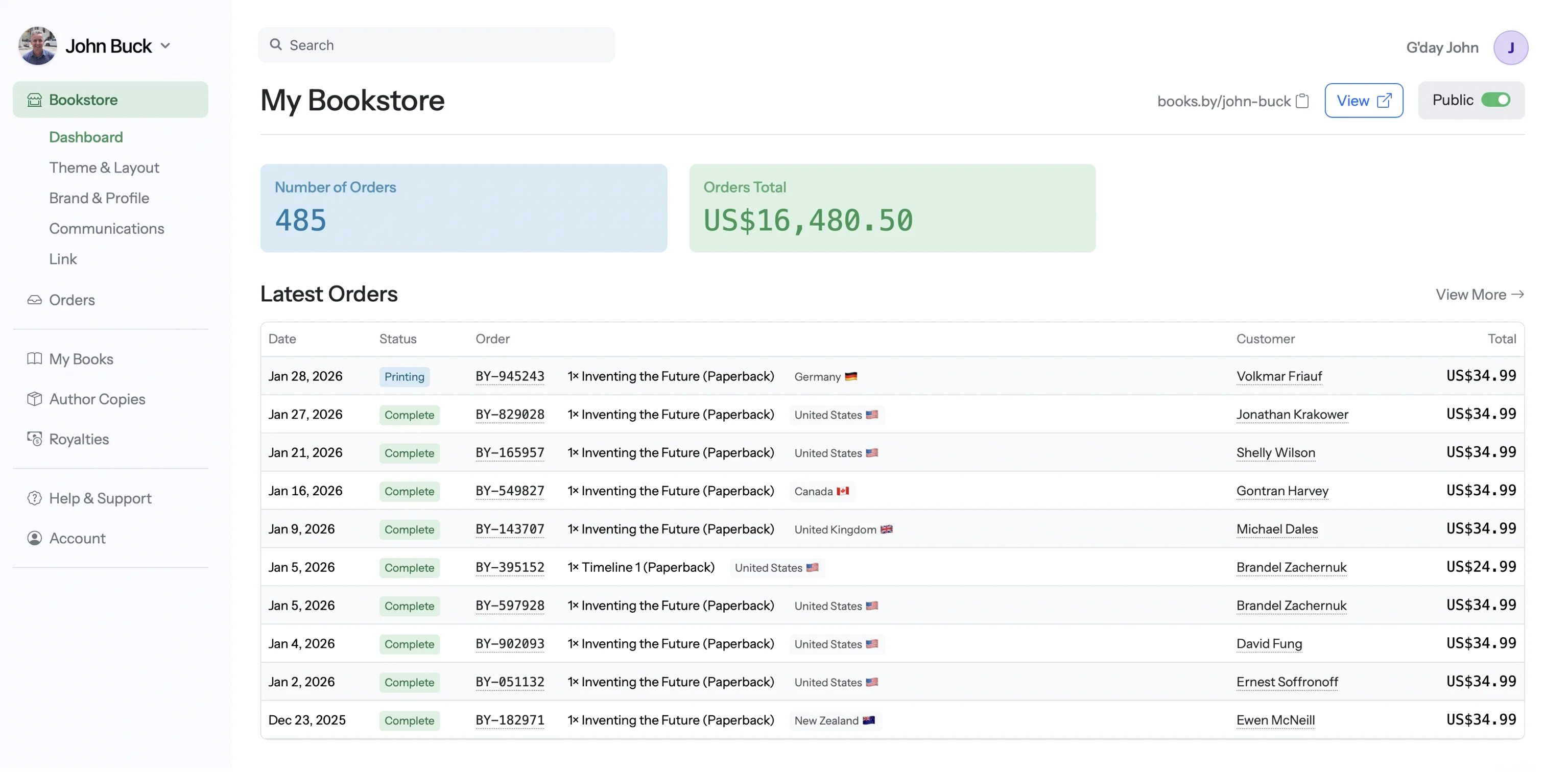
Books.by is a different kind of alternative. Instead of distributing to retailers, you sell directly to readers through your own branded storefront. Print-on-demand is built in. You keep 100% of royalties (only pay print cost + ~2.9% payment processing). Daily payouts. Full customer data with every sale.
The catch: No built-in traffic. You bring your own audience. This isn't a replacement for Amazon's organic discovery — it's for traffic you generate yourself. Your email list, social media, podcast, speaking events.
Best for: Authors with their own audience who want to maximize earnings on the traffic they control. Use KDP for Amazon discovery, Books.by for your own traffic. On a $19.99 paperback, you'd earn ~$5.74 on Amazon vs ~$9.60 on Books.by — 67% more.
Specialty formats and direct printing
Lulu has been around since 2002 — one of the original POD platforms. They offer formats other platforms don't: spiral binding, calendars, photo books, comic sizes. Good print quality and reasonable prices for author copies.
The catch: Their marketplace has limited traffic — you're not going to get many organic sales through Lulu.com. Their global distribution reaches Amazon and others, but the interface feels dated and they're less competitive for standard trade books where KDP and IngramSpark dominate.
Best for: Photo books, calendars, cookbooks, workbooks, and specialty projects. Also good for ordering bulk print copies at cost.
Direct access to B&N
B&N Press (formerly Nook Press) gives you direct access to Barnes & Noble's website and physical stores. Print books can be made available for in-store ordering. The Nook ebook store has a loyal customer base, though much smaller than Kindle.
The catch: Nook's market share keeps shrinking. B&N's online traffic is a fraction of Amazon's. It's worth adding if you're going wide, but don't expect significant sales volume. You can also reach B&N through IngramSpark or Draft2Digital.
Best for: Authors who want direct B&N access without IngramSpark fees. Add it if you're going wide — it's free and takes minimal effort.
Strong international ebook presence
Kobo is huge in Canada, Australia, and parts of Europe — markets where Amazon is less dominant. Their Kobo Plus subscription program offers additional reach. The platform is author-friendly with good promotional tools and responsive support.
The catch: Ebooks only — no print option. US market share is small (single digits). The 45% royalty tier kicks in below $2.99, which is worse than KDP. You can reach Kobo through D2D, but going direct gives you better royalties and access to Kobo Plus.
Best for: Authors with international audiences, especially Canada/UK/Australia. Essential if you're going wide on ebooks.
Premium ebook audience
Apple Books comes pre-installed on every iPhone, iPad, and Mac. Readers tend to be less price-sensitive than Kindle users — they'll pay full price. Apple takes 30%, leaving you 70% at any price (no KDP-style pricing restrictions).
The catch: You need a Mac to upload directly (Apple's tools are Mac-only), or you can go through Draft2Digital/Smashwords. Apple's discovery is weaker than Amazon's — organic sales are lower. But the audience quality is high.
Best for: Authors who can command higher prices and have audiences with Apple devices. Worth adding to any wide distribution strategy.
Here's what most successful indie authors actually do (rather than going all-in on one platform):
Send traffic you control (your email list, your social followers, your website visitors) to your highest-royalty option. Let Amazon have its cut on traffic it generates. Don't pay Amazon 40% on sales you created.
If you sell 100 copies of a $19.99 paperback:
All through Amazon: ~$574 in royalties
All through Books.by: ~$960 in royalties
50/50 split: ~$767 in royalties — 33% more than Amazon-only
It depends on your goal. For bookstore distribution: IngramSpark. For wide ebook distribution: Draft2Digital. For 100% royalties on direct sales: Books.by. Most authors use multiple platforms — KDP for Amazon + alternatives for everything else.
Yes, as long as you're not enrolled in KDP Select (which requires 90-day Kindle exclusivity for ebooks). Print books don't have exclusivity requirements, so you can publish print through KDP and other platforms simultaneously.
Common reasons include: KDP Select exclusivity requirements, low royalty rates (30-40% for many books), 60-day payment delays, no customer data access, no bookstore or library distribution, and lack of control over the customer relationship.
Some do. Direct sales platforms like Books.by pay 100% royalties (minus print and processing). However, distributor platforms like IngramSpark often pay lower royalties than KDP due to wholesale discounts. The key is using each platform strategically.
They serve different purposes. IngramSpark is better for bookstore/library distribution and offers higher print quality. KDP is better for Amazon sales and ebooks. Most authors use both — KDP for Amazon, IngramSpark for everywhere else. See our full KDP vs IngramSpark comparison.
Wait for your current KDP Select enrollment period to end (don't renew), then distribute your ebook through Draft2Digital, Apple Books, Kobo, and others. Your print book was never exclusive, so you can add IngramSpark or other print platforms anytime.
Keep using KDP for Amazon's organic traffic. Add Books.by for your own traffic — 100% royalties, daily payouts, customer data with every sale.
Start Your Bookstore →