A book distributor is a company that connects publishers with retailers, libraries, and other sales channels. They handle the logistics, ordering systems, and business relationships that make books available for purchase in stores and online.
Understanding distribution is one of those unglamorous but essential parts of publishing. Most readers have no idea how the book in their hands got from the author's laptop to the bookstore shelf. Most authors don't either — until they try to get their book into stores and hit a wall.
Here's how book distribution actually works, who the major players are, and what this means for your publishing strategy.
The Book Supply Chain: Who Does What
The traditional book supply chain has three main roles. Understanding the difference saves you from common confusion.
Publisher
Creates the book: editing, design, production. Owns or licenses the rights. Decides pricing and marketing.
Distributor
Gets books to retailers. Handles ordering systems, warehousing, shipping, and returns. The supply chain middleman.
Retailer
Sells to readers. Barnes & Noble, indie bookstores, Amazon. The customer-facing part of the chain.
There's also a fourth role that often confuses people:
Wholesalers: Buy books from various sources and resell to retailers. Unlike distributors, they don't have exclusive publisher relationships — they just stock and ship whatever books retailers want to order. Ingram actually functions as both distributor and wholesaler.
Why Distribution Matters
Here's the reality: a bookstore like Barnes & Noble or your local indie store cannot maintain direct relationships with thousands of publishers. They need a single point of contact where they can order any book in print.
That's what Ingram provides. When a bookstore employee looks up a book in their system and places an order, that order goes to Ingram. Ingram ships the book (from their warehouse or prints it on demand). The bookstore pays Ingram. Ingram pays the publisher.
Without distribution, your book simply doesn't exist in the bookstore ordering system. A customer can't special-order it. A store can't stock it. You're invisible to the entire physical retail channel.
Major Book Distributors
Ingram Content Group
The 800-pound gorilla. Ingram distributes to over 40,000 retailers, libraries, and online channels worldwide. If you want bookstore distribution, you're almost certainly going through Ingram one way or another. IngramSpark is their self-publishing arm.
Baker & Taylor
Major player, especially strong in library distribution. Many libraries order primarily through B&T. They also supply retailers, but Ingram has the larger retail footprint.
Independent Publishers Group (IPG)
Distributor for smaller and independent publishers. Provides warehousing, sales representation, and fulfillment. Works with trade publishers, not directly with individual self-publishers.
Publishers Group West (PGW)
Now part of Ingram. Handles distribution for independent publishers with a focus on sales representation and marketing support.
How Self-Publishers Access Distribution
Traditional distributors like IPG require you to be a legitimate publisher with multiple titles and professional operations. They don't work with individual self-publishers directly.
For self-publishers, there are two main paths to distribution:
1. IngramSpark
Ingram's self-publishing platform. Upload your book, set your wholesale discount and return policy, and your book appears in Ingram's global catalog. Bookstores can order it. Libraries can order it. You're in the system.
The catch: bookstores rarely stock self-published books. Being "available" means stores can order your book if a customer requests it — not that stores will stock it on shelves. For shelf placement, you typically need to approach stores directly.
2. Print-on-Demand Platforms
Print-on-demand has disrupted traditional distribution. Instead of pre-printing books and warehousing them, POD prints each book when ordered.
- Amazon KDP: Prints and sells through Amazon. Not traditional distribution — it's Amazon as both printer and retailer.
- IngramSpark: Prints on demand AND distributes through Ingram's network. Best of both worlds for bookstore access.
- Books.by: Prints on demand and ships directly to readers. Bypasses traditional distribution entirely — you are the retailer.
The Economics of Distribution
Here's why distribution eats into your royalties:
The wholesale discount problem: Retailers buy books at wholesale prices — typically 40-55% off the cover price. If your book retails for $20, the store pays $9-12. The distributor takes their cut from that. You get what's left after printing costs.
Using IngramSpark with a standard 55% wholesale discount on a $19.99 book:
- Cover price: $19.99
- Wholesale discount (55%): -$11.00
- Ingram's share: leaves $8.99
- Print cost (~200 pages): -$5.24
- Your royalty: $3.75
Compare that to selling direct through Books.by:
- Cover price: $19.99
- Print cost: -$4.46
- Payment processing (~3%): -$0.89
- Your royalty: ~$9.60 (after print + shipping at cost)
That's roughly 4x the profit per book. Distribution is expensive. It has value — but be clear-eyed about the cost.
Do You Need Traditional Distribution?
The honest answer: probably not, unless you have specific bookstore goals.
You need distribution if:
- You want your book in physical bookstores (not just orderable, but stocked)
- You do speaking or events where bookstores will host you
- You want library access (libraries order through Ingram/Baker & Taylor)
- Having a "legitimate" distribution presence matters for your credibility
You probably don't need it if:
- You sell primarily online
- Your traffic comes from your own marketing (email, social, podcast)
- You want maximum royalties over maximum reach
- You're realistic that bookstore placement is unlikely anyway
Most indie authors sell the vast majority of their books online — through Amazon, their own site, or direct sales. Traditional distribution sounds impressive but rarely delivers meaningful bookstore sales for self-publishers.
The Direct Sales Alternative
Here's the perspective shift: traditional distribution exists because publishers needed a way to get books to stores before readers bought online. Now that readers do buy online, you can be your own retailer.
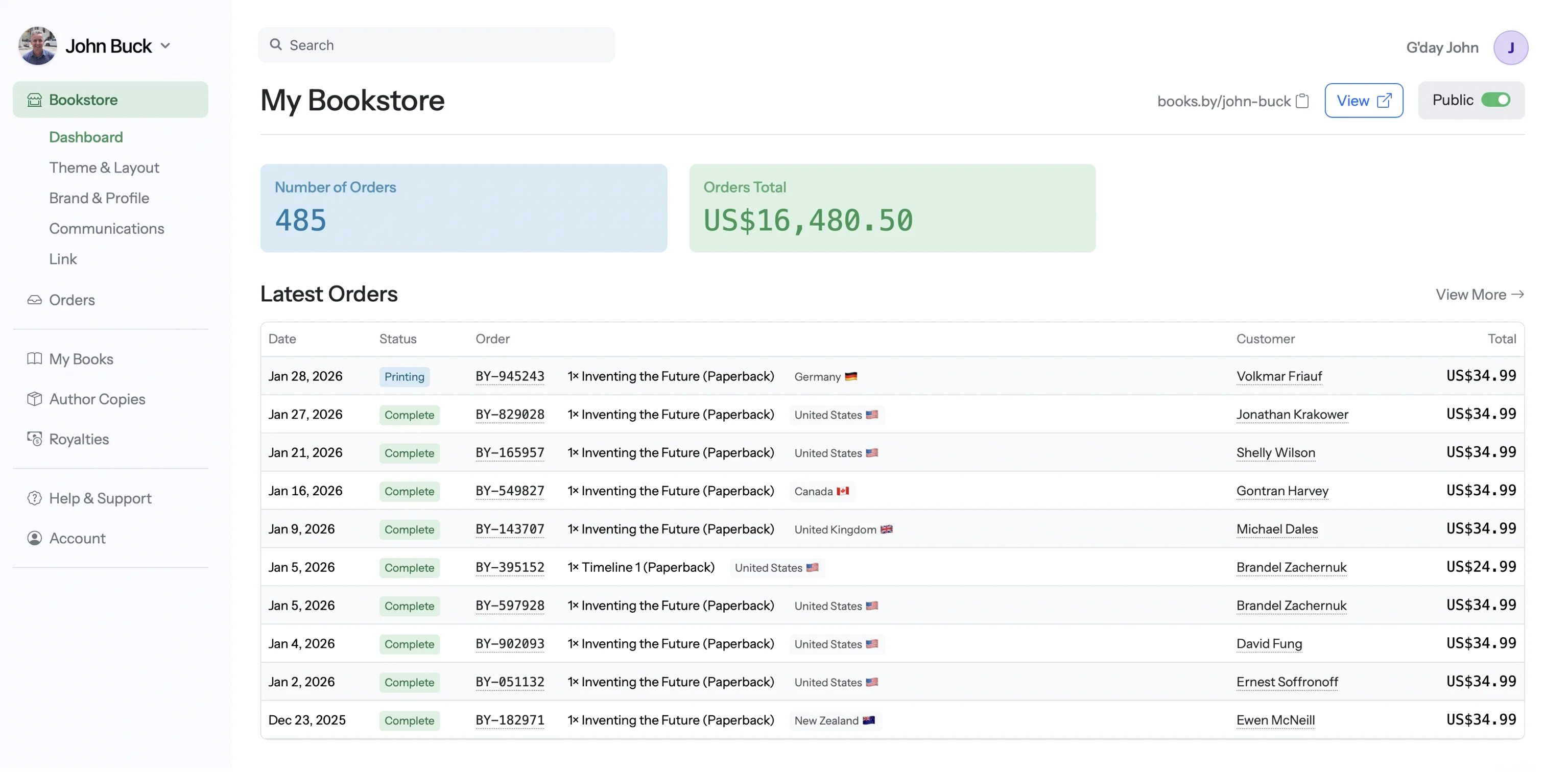
With Books.by, you sell directly from your own branded storefront. There's no distributor taking a cut. No retailer taking a cut. Just you, your book, and your reader — with print-on-demand handling the printing and shipping.
Use IngramSpark for bookstore availability if you want it. Use Amazon for marketplace discoverability. Use Books.by for your own traffic — email subscribers, social media followers, podcast listeners — where you keep nearly everything.
Frequently Asked Questions
A book distributor is a company that gets books from publishers into the hands of retailers, libraries, and other sales channels. They handle logistics, ordering systems, warehousing, and the business relationships that make books available in stores. Think of them as the supply chain between publisher and bookshelf.
Retailers sell books directly to readers (Amazon, Barnes & Noble, independent bookstores). Distributors sell books to retailers, who then sell to readers. A distributor like Ingram supplies thousands of bookstores; those bookstores sell to customers. Different roles in the same supply chain.
Only if you want bookstore or library distribution. For online-only sales, print-on-demand platforms like Amazon KDP and Books.by handle fulfillment directly. For bookstore presence, you would use IngramSpark, which provides distribution through Ingram's network.
Ingram Content Group is the world's largest book distributor, supplying books to over 40,000 retailers, libraries, and online channels globally. In the US, Baker & Taylor is another major player, particularly for library distribution.
Distributors have exclusive or semi-exclusive arrangements with publishers and provide sales, marketing, and fulfillment services. Wholesalers simply buy books from any available source and resell them to retailers. Ingram functions as both — they distribute for publishers and wholesale to retailers.
POD platforms combine printing and distribution. IngramSpark prints books on demand and distributes through Ingram's network. Amazon KDP prints and sells through Amazon's retail channel. Books.by prints on demand and ships directly to readers. They bypass traditional distribution by manufacturing books only when ordered.
Bookstores cannot manage relationships with millions of individual publishers. They need to order from a single source that aggregates inventory from thousands of publishers. Distributors provide this consolidation, along with standard ordering systems, returns handling, and reliable shipping.