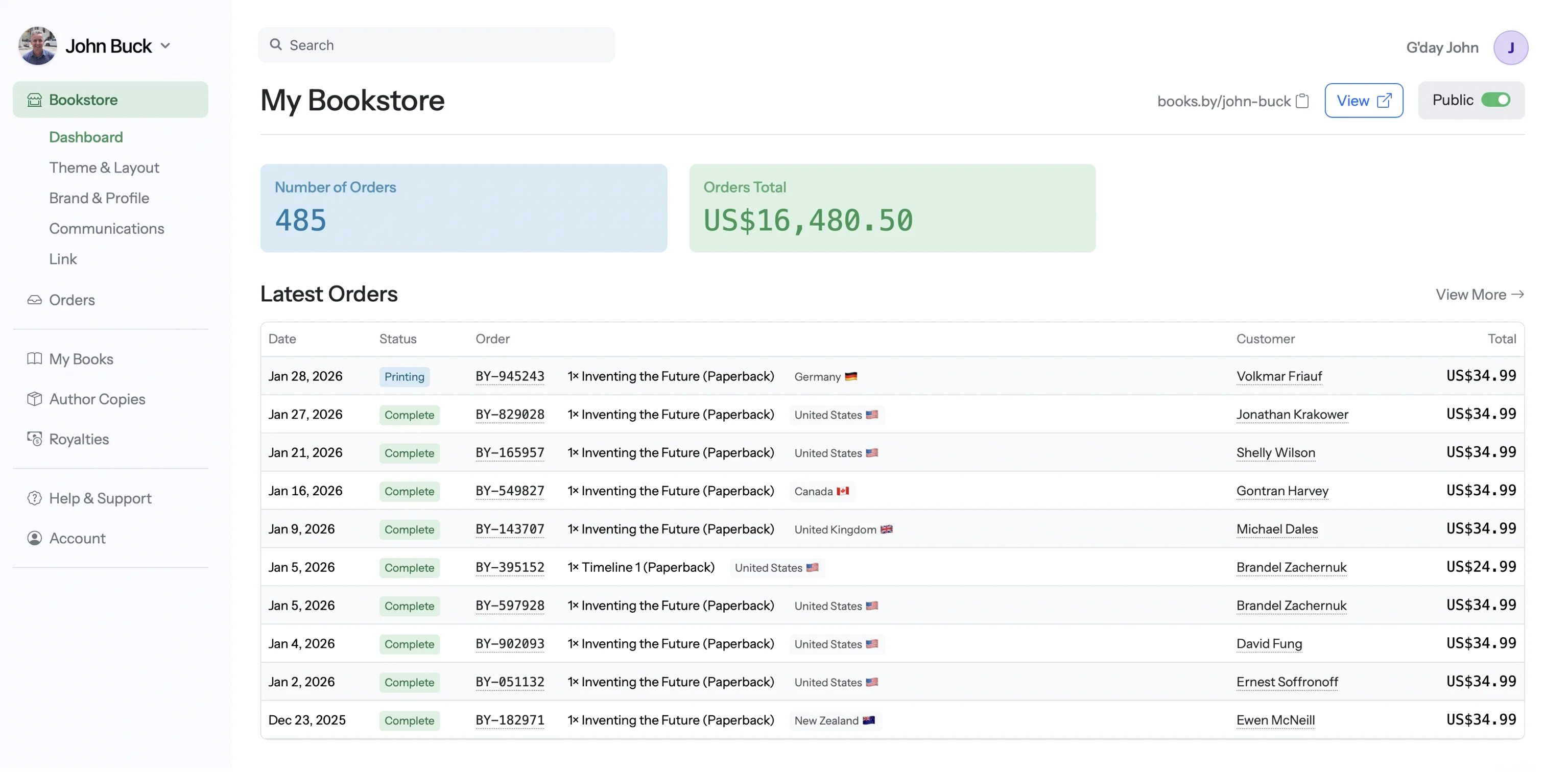
Here's a truth that fiction authors won't tell you: when you're publishing a business book, you're not in the book-selling business. You're in the credibility business. The authority business. The "one client from this book is worth $50,000" business.
Traditional authors obsess over royalties per book. Smart business authors think differently. They see a book as the most powerful marketing asset they'll ever create — a 200-page sales letter that people pay to read, that lives on their bookshelf for years, and that positions them as the obvious expert in their field.
The consultant who wrote the book gets the speaking gig over the one who didn't. The coach with a published methodology attracts premium clients who come pre-sold. The agency founder who authored the definitive guide in their niche becomes the default recommendation in every industry conversation.
This guide shows you exactly how to create, publish, price, and sell a business book that builds your authority and generates real revenue — both directly from book sales and indirectly from the opportunities it creates.
Why Every Business Should Have a Book
A book does things no other marketing asset can do. Your website can be dismissed in seconds. Your LinkedIn posts disappear into the feed. Your business cards end up in desk drawers and eventually recycling bins. But a book? A book gets kept. Read. Referenced. Recommended.
Here's what a book actually does for your business:
The Numbers: What Books Do for Business Revenue
Let's ground this in reality with actual data from business authors:
- Consulting rate increase: Business authors report raising their rates by 30-50% within a year of publishing, citing the book as their primary justification.
- Speaking fees: Authors command 2-5× higher speaking fees than non-authors in the same field. A book is often the difference between speaking for free and getting paid $5,000-$25,000 per keynote.
- Client acquisition: One study of professional service firms found that partners with books generated 3× more inbound inquiries than those without.
- Sales cycle reduction: Prospects who've read your book arrive at sales conversations 60-80% through the buying process. They already trust you. The "convince them you're credible" phase is done.
The "Book as Business Card" Strategy
Forget what you know about traditional publishing economics. When you're a business author, your book's job isn't primarily to make money from sales — it's to be the most effective business card ever invented.
Why a Book Beats Every Other Leave-Behind
| Marketing Asset | Perceived Value | Shelf Life | Authority Signal |
|---|---|---|---|
| Business Card | Near zero | Hours (then trash) | None |
| Brochure | Low | Days | Minimal |
| White Paper PDF | Medium | Weeks (in email) | Some |
| Printed Book | High ($20-$30) | Years (on shelf) | Maximum |
When you hand someone a book, you're not giving them something to throw away. You're giving them something they feel obligated to keep, read, and value. The psychology is completely different.
How to Use Your Book as a Business Card
Conferences & Networking Events
Instead of handing out cards that end up lost, hand out copies of your book. "Here, take my book" is infinitely more memorable than "Here's my card." Order copies at cost through Books.by's print-on-demand — no inventory, no waste, just order what you need for each event.
Sales Meeting Leave-Behinds
End every sales meeting by leaving a signed copy on the table. "I wrote a book that goes deeper on everything we discussed. Take this, and call me when you're ready." This keeps you top-of-mind and continues selling after you've left the room.
Strategic Gifting
Send books to prospects, partners, and referral sources. A $5 book (at cost) that leads to a $15,000 contract is the best ROI marketing you'll ever do. Personalize with a handwritten note: "Thought you'd appreciate Chapter 4 given our conversation about [topic]."
Event Giveaways
Speaking at an event? Offer books to all attendees. The event organizer may even buy them for you (wholesale pricing through your Books.by store). Everyone leaves with your book, your ideas, and your contact information.
Types of Business Books: Finding Your Format
Not all business books are created equal. The type of book you write should match your business model, your expertise, and how you want to be positioned in the market. Here are the four most effective formats:
Choosing the Right Format for Your Goals
Writing Your Business Book: From Expertise to Manuscript
The biggest obstacle to publishing a business book isn't publishing — it's writing. Good news: you don't have to be a professional writer to create a valuable business book. Here are proven approaches that work for busy professionals:
Option 1: Repurpose Existing Content
You've probably already created most of your book without realizing it. Look at:
- Blog posts and articles — Your top 20 posts, organized into chapters, might be 60% of a book.
- Presentations and workshops — Transcribe your best talks. Your keynote is a chapter. Your full-day workshop is half a book.
- Client frameworks — The methodology you use with every client, explained step-by-step.
- Email sequences — Your nurture sequence content, expanded and organized.
- Podcast episodes — Transcribe your appearances or your own show. Edit for clarity.
Option 2: Hire a Ghostwriter
Ghostwriting is standard practice in business publishing. Many bestselling business books were written with significant ghostwriter involvement. The author provides the ideas, frameworks, stories, and voice; the ghostwriter structures it into a readable manuscript.
Costs range widely:
- Budget ghostwriter: $5,000-$15,000 (less experienced, may require more direction)
- Professional ghostwriter: $20,000-$50,000 (experienced, can work from interviews)
- Premium ghostwriter: $50,000-$150,000+ (bestseller experience, minimal author input needed)
The investment makes sense when your book will generate six-figure+ business opportunities. A $30,000 ghostwriter fee is nothing compared to the speaking gigs, consulting contracts, and authority positioning the book creates.
Option 3: AI-Assisted Writing
AI tools like ChatGPT, Claude, and specialized writing assistants can dramatically accelerate your book process. Effective approaches include:
- Outline expansion: Give AI your chapter outline and ask it to expand each point into draft paragraphs you can refine.
- Interview transcription: Record yourself explaining concepts (like you're talking to a client), transcribe with AI, then edit into chapters.
- Case study drafting: Describe a client situation to AI and ask it to draft a case study narrative.
- Editing and polish: Use AI to improve clarity, check flow, and suggest better explanations.
Option 4: The Interview Method
Can't face a blank page? Talk instead. Have someone interview you (or use AI transcription while you record yourself explaining your methodology). 10 hours of recorded interviews, transcribed and edited, becomes a book manuscript. Many busy executives use this approach — they speak their expertise, and an editor shapes it into chapters.
Print-on-Demand vs Traditional Publishing for Business Authors
Twenty years ago, business authors had two choices: land a traditional publishing deal or pay $20,000+ for a vanity press. Today, print-on-demand (POD) has completely changed the economics. Here's how they compare:
| Factor | Traditional Publisher | Print-on-Demand (Books.by) |
|---|---|---|
| Upfront cost | $0 (they pay you an advance) | $99/year + editing/design costs |
| Timeline to publish | 18-24 months minimum | Days to weeks |
| Royalty per book | 10-15% of net (often $1-$2) | 100% above print cost ($10-$15+) |
| Control over content | Limited (editor's decisions) | Complete |
| Control over pricing | None | Complete |
| Rights ownership | Publisher owns rights for years | You own all rights, always |
| Inventory risk | None (but out-of-print possible) | None (printed per order) |
| Prestige/credibility | High (major publisher name) | Medium (improving rapidly) |
| Access to bookstores | Yes (major retailers) | Limited (Amazon primary) |
Why Most Business Authors Should Choose POD
Traditional publishing makes sense if you're optimizing for prestige and bookstore placement. But for most business authors, the goals are different: you want speed, control, and the ability to use your book strategically in your business.
Consider the traditional publishing timeline:
- Write a book proposal (2-6 months)
- Find an agent (3-12 months of rejection)
- Agent shops book to publishers (3-6 months)
- Publisher edits, designs, schedules (12-18 months)
- Total: 2-4 years from idea to published book
With print-on-demand through Books.by:
- Write your manuscript (whatever timeline works for you)
- Edit and design (1-3 months with professionals, or DIY)
- Upload and publish (same day)
- Total: As fast as you can write and produce it
Pricing Strategy for Business Books
Pricing a business book is fundamentally different from pricing fiction. Your readers aren't looking for cheap entertainment — they're looking for expertise that helps their business. Price accordingly.
The Psychology of Business Book Pricing
Don't underprice. This is the most common mistake business authors make. A $9.99 business book signals amateur content. Readers think: "If this person's advice is worth so little, is it worth my time?"
The book everyone talks about as transformational isn't the $9.99 one — it's the $24.99 one with the premium cover that looks impressive on a shelf. Price communicates value before anyone reads a word.
Format-Specific Pricing Guidelines
| Format | Recommended Price Range | Your Profit (Books.by) |
|---|---|---|
| Ebook | $9.99-$14.99 | $9.99-$14.99 (100%) |
| Paperback (200-250 pages) | $17.99-$24.99 | $12-$19 (after ~$5 print cost) |
| Hardcover | $27.99-$39.99 | $18-$28 (after ~$10 print cost) |
Where to Sell: Amazon, Direct Sales, or Both?
Smart business authors use a dual-channel strategy: Amazon for discovery and credibility, direct sales for profit and lead capture. Here's how to think about each:
- Discovery: People search Amazon for books on your topic. Organic traffic you don't have to generate.
- Credibility: "Available on Amazon" and "Amazon Bestseller" badges carry weight.
- Reviews: Amazon reviews are the gold standard for social proof.
- 100% royalties: Keep $14+ on the same $19.99 paperback.
- Customer emails: Every buyer goes on your email list for follow-up marketing.
- Bundle options: Offer print + free ebook download together.
- Branded storefront: books.by/yourcompany looks professional.
The Optimal Strategy: Amazon + Direct
- List on Amazon for organic search traffic, reviews, and the credibility of being "on Amazon."
- Send all traffic you control to your direct store — your email list, social media, speaking events, website visitors.
- Use Amazon for credibility, Books.by for profit. Amazon is your storefront window; Books.by is where you make the real money.
When someone Googles your name and sees your book on Amazon, that's credibility. When your email list clicks your link and buys direct, that's profit and you capture their email for future campaigns.
Ready to publish your business book?
Books.by gives you a professional author storefront, 100% royalties, and customer emails with every sale. Built for business authors who want results.
Start Your Books.by Store — $99/yr →How Books.by Works for Business Authors
Books.by was built for authors who want to sell direct — and business authors are the ones who benefit most. Here's exactly what you get:
Your Own Branded Storefront
Get a professional author page at books.by/yourcompany or books.by/yourname. Clean, professional, and memorable. Perfect for business cards, email signatures, and speaking slides.
100% Royalties — No Commission
Unlike Amazon (which takes 60%+ on paperbacks), Books.by takes zero commission. You keep 100% of your book's profit above print cost. $99/year flat — no per-sale fees, no surprises.
Print-on-Demand: No Inventory, No Risk
Books are printed and shipped only when ordered. No upfront investment in 1,000 copies sitting in your garage. Order 10 for an event or 500 for a campaign — same low print cost either way.
Free ISBNs Included
ISBNs cost $125 each if you buy direct (or $295 for 10). Books.by includes free ISBNs with your subscription — one less thing to worry about.
Bundle Print + Free Ebook Download
Offer paperback buyers a free ebook copy. It costs you nothing and adds perceived value. Perfect for readers who want both formats.
Collect Customer Emails with Every Sale
This is the game-changer for business authors. Every buyer's email address goes into your dashboard. Export anytime to your email marketing tool. Build your list while selling books.
Buy in Bulk at Cost for Events
Need 200 copies for a conference? Order through your author dashboard at print cost (~$4-$6 per book). No markup, no minimum orders. Perfect for strategic gifting and giveaways.
Professional Cover Builder
Don't have a designer? Use Books.by's built-in Cover Builder to create a professional book cover. Templates, customization, and print-ready export included.
From our team: "Business authors are our most successful users. They understand that the book is a means to an end — credibility, leads, and high-ticket sales. Our 100% royalty model means more money for marketing, more copies for strategic gifting, and more profit when sales come through." — Ash Davies, Founder
Marketing Your Business Book
A business book won't market itself. But the good news is that your existing business activities become book marketing activities. Here are the highest-ROI channels for business authors:
1. Speaking & Events
Every speaking opportunity is a book marketing opportunity:
- Mention your book from stage (naturally, not salesy)
- Negotiate book giveaways as part of your speaker agreement
- Have copies available at the back of the room
- Use slides that show your book cover
- Offer a signed copy to everyone who comes up afterward
2. Podcast Appearances
Podcast guesting is the most underrated book marketing channel for business authors:
- Target podcasts in your niche (there are thousands with engaged audiences)
- Use your book as a natural talking point
- Offer listeners a special deal (free chapter, discount code)
- Mention your Books.by URL at the end of every interview
3. LinkedIn Content
For B2B business authors, LinkedIn is often the highest-converting social platform:
- Share excerpts from your book (with "Read more in Chapter 3 of [Book Title]")
- Post about the book's themes and get engagement from your professional network
- Add "Author of [Book Title]" to your headline
- Pin a post about your book to the top of your profile
- Comment on relevant posts mentioning your book's perspective
4. Email List
Your existing email list is your launch weapon. Even a small list of 500 engaged subscribers can generate significant launch momentum:
- Build anticipation with "book is coming" emails in the weeks before launch
- Send a launch announcement with a direct link to your Books.by store
- Follow up with early reviews and testimonials
- Offer email subscribers exclusive bonuses or early access
5. Strategic Gifting
This is the most underleveraged marketing channel for business books:
- Send books to potential clients before sales calls
- Gift to industry influencers who might mention it
- Send to journalists and podcast hosts you want to feature you
- Give to referral partners with a note asking them to share
Remember: with Books.by, you can order at cost. A $5 book that leads to a $20,000 client is a 400,000% ROI. Be generous with strategic gifting.
Using Books to Drive High-Ticket Sales
Here's where business book publishing gets interesting. Your $20 book can generate clients worth $20,000, $50,000, or $200,000+. The key is designing your book and sales process to work together.
The Book-to-Client Pipeline
Reader Discovers Your Book
Through Amazon search, a podcast appearance, a conference, or your content marketing. They buy your book (or receive it as a gift).
Book Educates & Pre-Sells
They spend 4-8 hours with your ideas. They learn your methodology. They see your case studies. They begin to trust you and see you as the expert.
Clear Next Step at the End
Your book's conclusion offers a clear path forward: "If you'd like help implementing this, visit [URL] or email [address]." Make it easy to take the next step.
Qualified Lead Reaches Out
This prospect is pre-sold. They understand your approach. They've invested hours consuming your content. They're not shopping — they're ready to discuss working together.
Shortened Sales Cycle
The "who are you and why should I trust you" phase is already done. The sales conversation is about fit and logistics, not credibility. Close rates increase; sales cycles shrink.
Designing Your Book for Conversion
- Include clear calls-to-action — at minimum in the conclusion, ideally at the end of each chapter.
- Offer a resource page — "Download the templates mentioned in this book at [URL]" captures emails and creates a direct connection.
- Tell client stories — Readers should see themselves in your case studies and think "I want that result too."
- Be specific about who you help — "I work with B2B SaaS companies doing $5-$50M in revenue" attracts exactly those readers.
- Don't hide your offer — Being coy about what you sell is false modesty. If consulting is how you help people, say so.
📊 Business Book ROI Calculator
See how the math works for your business. Adjust the values to match your situation.
What's Your Book Really Worth?
Calculate the ROI of publishing a business book based on your client value and conversion rates
Est. Annual Publishing Cost
$1,099
Revenue From Book Clients
$20,000
Return on Investment
1,720%
Cost assumes $99 Books.by subscription + $5 average cost per book for strategic gifting. Does not include book revenue from direct sales, speaking fees from book-driven invitations, or consulting rate increases.
Common Mistakes Business Authors Make
Frequently Asked Questions
A book establishes you as a credible authority in your field. It opens doors to speaking engagements, podcast interviews, and media coverage. It serves as a premium business card that clients keep instead of throw away. Most importantly, it pre-sells your services — readers who finish your book arrive at sales conversations already trusting you, dramatically shortening the sales cycle.
With print-on-demand through Books.by, you can publish a professional business book for as little as $99/year (your Books.by subscription) plus printing costs per book ($4-$6 for a typical 200-page paperback). There's no upfront inventory investment. If you hire professionals for editing ($1,000-$3,000), cover design ($300-$800), and formatting ($200-$500), budget $2,000-$5,000 total. Or use Books.by's free Cover Builder and handle everything yourself for under $500.
Ideally, both — but for different purposes. Amazon provides discovery and credibility (bestseller badges, reviews). Your own storefront (like Books.by) provides higher profits (100% royalties vs ~25% on Amazon paperbacks) and customer email addresses for follow-up marketing. Send paid traffic and your email list to your direct store. Let Amazon handle organic search traffic.
Business books typically command premium prices: $17.99-$24.99 for paperbacks, $24.99-$34.99 for hardcovers. Don't underprice — a $9.99 business book signals amateur advice. Remember: your book's job isn't to make money directly; it's to position you as an authority and generate high-ticket client inquiries. One consulting client from your book can be worth $10,000-$100,000+.
Most successful business books are 30,000-50,000 words (150-250 pages). Shorter can work if the content is highly actionable — many top business books are under 40,000 words. Don't pad your book to hit an arbitrary length. Business readers value concision and actionable insights over length.
Yes, both are legitimate options. Many bestselling business authors use ghostwriters ($15,000-$50,000+ for a full book). AI tools like ChatGPT can help structure your ideas, draft chapters, and overcome writer's block — though the best results come from combining AI assistance with your genuine expertise and voice. The key is that the ideas and frameworks must be authentically yours.
Your Book. Your Business. Your Storefront.
Books.by gives business authors what they need: 100% royalties, customer email capture, bulk ordering at cost, and a professional branded storefront. All for $99/year.
Start Your Books.by Store — $99/yr →Daily payouts · Free ISBNs · Cancel anytime