Low-content books are one of the most accessible entry points into the publishing business. You don't need to write 80,000 words. You don't need a platform or an audience. You need a good niche idea, basic design skills, and a print-on-demand account. Some sellers create their first product in an afternoon and start earning within weeks.
But the low-content space has gotten significantly more competitive since the pandemic-era gold rush. The days of uploading a plain lined notebook and watching sales roll in are over. In 2026, success requires smarter niche selection, better design quality, and a multi-platform strategy that includes selling direct for higher margins.
This guide gives you the complete playbook — from finding profitable niches to designing professional products to optimizing your listings for maximum visibility and sales.
What Are Low-Content Books?
Low-content books are printed products where the publisher provides minimal content and the reader fills in the rest. Think of them as structured blank spaces — lines to write on, boxes to check, prompts to respond to, pages to color.
The spectrum runs from "no content" (completely blank notebooks) to "medium content" (workbooks with substantial text and exercises):
Why Low-Content Books Are Still Profitable in 2026
Despite increased competition, several factors make low-content publishing attractive:
Types of Low-Content Books That Sell
The highest-selling categories share a common trait: they solve a specific problem or serve a specific audience. "Journal" is too generic. "Gratitude Journal for New Mothers" is a product with a clear buyer.
High-Demand Categories
Niche Research & Selection
Niche selection is the single biggest factor in your success. A great design in the wrong niche will fail. A decent design in the right niche will succeed. Here's how to find profitable niches:
The Amazon BSR Method
Search Amazon for your product type
Search for "gratitude journal" or "fitness planner" or whatever niche you're considering. Look at the top 20 results. Note their Best Sellers Rank (BSR) — you'll find it in the product details section.
Evaluate demand vs competition
Sweet spot: niches where the top 10 results have BSRs between 5,000–100,000 in Books. Below 5,000 = very competitive. Above 200,000 = not enough demand. You want moderate demand with room for a new entrant.
Check review counts
If the top results all have 1,000+ reviews, it's very hard to compete. If several results have under 100 reviews, there's opportunity. New entrants can compete where incumbents haven't dominated yet.
Analyze covers and quality
Can you create a better cover than what's currently ranking? If the top results have amateur covers and poor descriptions, you can differentiate on quality alone. If they're all polished, you'll need a unique angle.
Keyword Research Tools
Design Tools & Templates
You don't need to be a graphic designer. The right tools make it possible to create professional-quality interiors and covers even if you've never opened a design program.
Design Tool Comparison
| Tool | Price | Skill Level | Interior Design | Cover Design | Templates | Best For |
|---|---|---|---|---|---|---|
| Canva Free | $0 | Beginner | ✓ | ✓ | ✓ | Starting out |
| Canva Pro | $13/mo | Beginner | ✓ | ✓ | ✓✓ | Serious beginners |
| Book Bolt | $10/mo | Beginner | ✓✓ | ✓ | ✓✓ | Low-content specialists |
| Affinity Publisher | $70 once | Intermediate | ✓✓✓ | ✓✓ | — | Long-term value |
| Adobe InDesign | $23/mo | Advanced | ✓✓✓ | ✓✓✓ | ✓ | Professionals |
| Google Docs/Slides | $0 | Beginner | ✓ | — | — | Ultra-simple products |
Creating Your First Low-Content Book
Let's walk through creating a journal from scratch. We'll use a "Gratitude Journal for Teachers" as our example — a specific enough niche to avoid the generic competition.
Step 1: Plan Your Interior
A well-designed journal interior includes more than just lines. Here's a structure that commands a premium price:
- Title page — "This Journal Belongs To" with a fill-in line
- Introduction page — A brief note on the practice of gratitude (2–3 paragraphs)
- How to use this journal — Simple instructions
- Daily pages (×90) — Date line, "Today I'm grateful for:" with 3 numbered lines, "One good thing that happened:" prompt, space for reflection
- Monthly reflection pages (×3) — End-of-month review with prompts
- Inspirational quotes — Scatter teacher-relevant quotes every 10 pages
- Notes pages — 5–10 blank lined pages at the back
Step 2: Design Your Interior
Create a master template page, then duplicate it for the full book. Key specs:
Step 3: Design Your Cover
Your cover is your #1 marketing tool. For low-content books, the cover needs to:
- Clearly communicate what the product is — "Gratitude Journal for Teachers" in readable text at thumbnail size
- Look professional at small sizes — Amazon thumbnails are tiny. Bold text, high contrast, simple design.
- Match the audience aesthetic — A teacher's journal might use warm colors, apple imagery, or chalkboard textures. A fitness planner might use bold, energetic colors.
- Include spine text — For books over 100 pages, you can add text to the spine. Include the title and your brand name.
Platform Comparison: Where to Sell Low-Content Books
Your platform choice determines your reach, your margins, and your growth potential. Most successful sellers use multiple platforms.
| Feature | Amazon KDP | IngramSpark | Books.by | Lulu |
|---|---|---|---|---|
| Setup cost | Free | $49/title | $99/yr (unlimited) | Free |
| Royalty (on $12.99 book) | ~$2.50 (35–60%) | ~$3.50 | ~$8.80 (100%) | ~$2.00 |
| Customer email data | ✗ | ✗ | ✓ | ✗ |
| Organic traffic | ✓✓✓ | ✓ | You drive traffic | ✓ |
| Print quality | Good | Excellent | Excellent | Good |
| Payout speed | 60 days | 90 days | Daily | 30 days |
| Free ISBN | ✓ (Amazon-owned) | ✗ | ✓ (You own it) | ✓ (Lulu-owned) |
| Bookstore distribution | ✗ | ✓✓✓ | Direct sales | ✓ |
From Ash Davies, Founder: "Most low-content book guides focus entirely on Amazon KDP. That's leaving money on the table. The authors in our community who earn $3,000+/month from journals are the ones who built a direct sales channel alongside Amazon. Amazon for discovery, your own store for profit." — Ash Davies, Books.by
Listing Optimization: Getting Found & Selling
A great product with a poor listing won't sell. Listing optimization is how you turn browsers into buyers and climb the search rankings.
Title Optimization
Your title should include your primary keyword plus descriptors that help shoppers and the algorithm. Formula:
Example: "Gratitude Journal for Teachers: Daily Reflection & Mindfulness Prompts for Educators | 6×9, 120 Pages"
Description Best Practices
- Lead with benefits, not features. "Start each day with gratitude and end it with clarity" beats "120 lined pages with prompts."
- Use bullet points — Amazon and most platforms support HTML bullets. Break key features into scannable points.
- Include keywords naturally — Weave in variations of your target keywords without keyword stuffing.
- Mention the gift potential — "Makes a perfect end-of-year gift for the teacher who changed your life."
- Specify physical details — Size, page count, paper quality, cover type (matte vs glossy). Buyers want to know what they're getting.
Category Selection
Choose the most specific category available. "Books > Self-Help > Journals" is better than "Books > Self-Help." On Amazon, you can request up to 10 categories via author support — take advantage of this. On Books.by, tag your book with relevant categories and let the search engine do its work.
Niche Profitability Calculator
Estimate your potential earnings based on niche volume, pricing, and platform choice:
💰 Low-Content Book Profitability Estimator
Adjust the inputs to see projected monthly earnings
KDP Revenue
$75
Direct Revenue
$88
Total Monthly
$163
Print cost estimated at $1.00 fixed + $0.012/page for B&W interior. KDP royalty = 60% × (price − print cost). Books.by = 100% × (price − print cost).
Sell Your Journals Direct — Keep 100% of Royalties
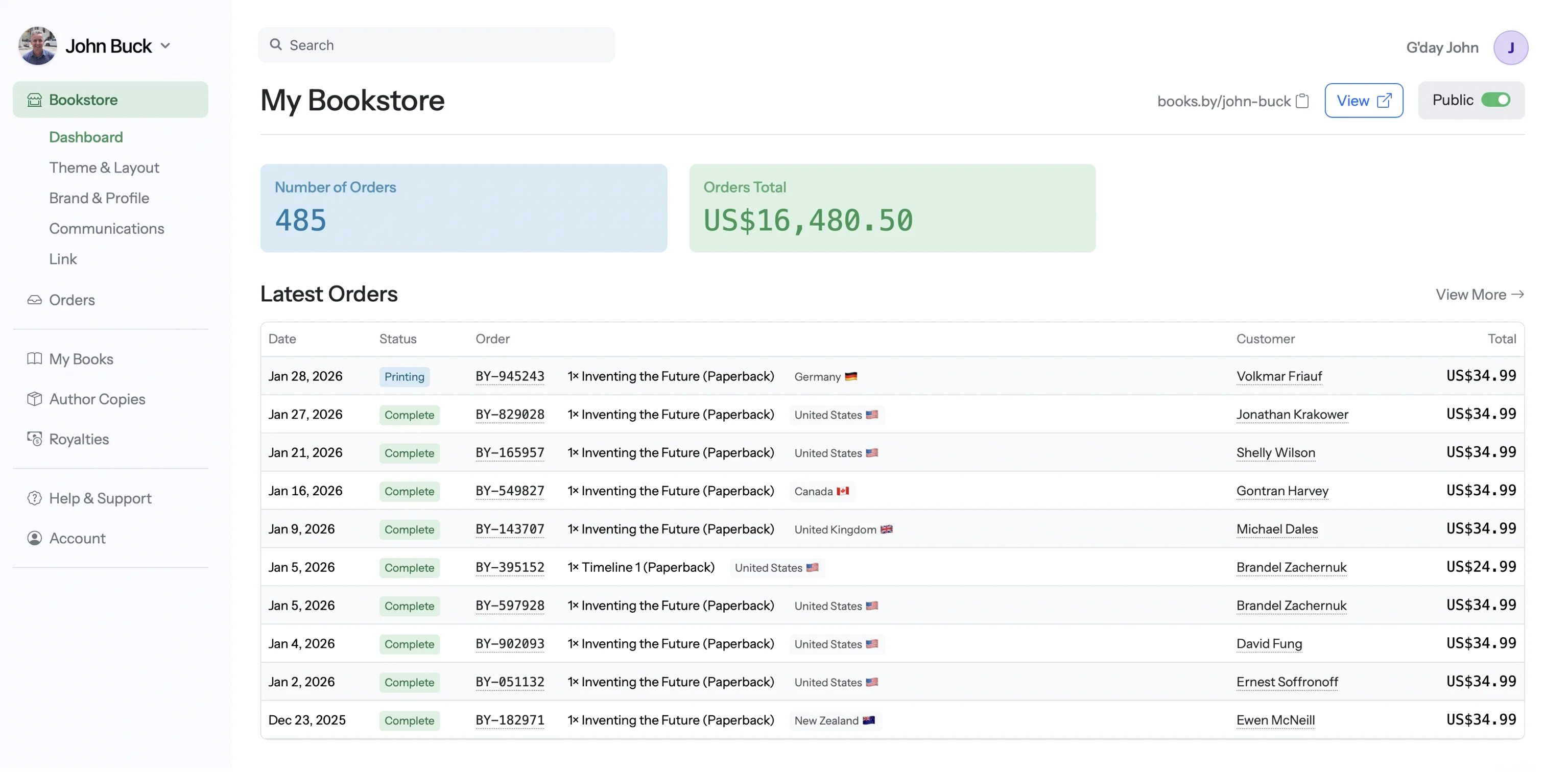
Why earn $2.50 on Amazon when you could earn $8.80 on Books.by? Set up your own branded store at books.by/yourname and start earning real margins on your low-content books.
Start Selling Direct — $99/yr →Scaling Your Low-Content Book Business
The real money in low-content publishing comes from scale. One journal earning $100/month is a nice side hustle. Fifty journals earning $100/month is a full-time income. Here's how to scale intelligently:
The Variation Strategy
Once you find a winning product, create variations:
- Different covers: Same interior, 5–10 different cover designs. Test which aesthetics convert best.
- Different audiences: "Gratitude Journal for Teachers" → "Gratitude Journal for Nurses" → "Gratitude Journal for Parents"
- Different sizes: Offer the same journal in 5×8", 6×9", and 8.5×11"
- Seasonal editions: Holiday-themed covers for Q4 gift season (plan these in August–September)
- Series branding: Create a recognizable brand across your product line
Building a Brand (Not Just Products)
The most successful low-content sellers build recognizable brands that customers seek out. This is where selling direct through Books.by becomes especially powerful:
- Create a brand identity: Consistent logo, color scheme, and design language across all products
- Build your email list: Every Books.by sale gives you the customer's email. Email them when you launch new products. This is infinitely more reliable than hoping Amazon shows your new listing to past buyers.
- Pinterest marketing: Pinterest is the #1 social platform for low-content book discovery. Create beautiful pins linking to your Books.by store.
- Seasonal promotions: Back-to-school planners in August, New Year's goal journals in December, Mother's Day journals in April. Plan your calendar 3 months ahead.
Revenue Milestones
- Products 10–20 listings
- Platforms KDP only
- Marketing Keywords + organic
- Time invested 5–10 hrs/week
- Products 30–80 listings
- Platforms KDP + Books.by
- Marketing Pinterest + email
- Time invested 10–20 hrs/week
- Products 100+ listings
- Platforms Multi-platform + direct
- Marketing Paid ads + organic + email
- Time invested 20+ hrs/week
Common Mistakes to Avoid
- Going too broad: "Journal" will never rank. "Sourdough Bread Baking Log Book" will.
- Ignoring cover quality: Your cover is the only thing shoppers see before clicking. A $5 Fiverr cover won't compete.
- Not testing enough: Your first 5 products are experiments. Track what sells, double down on winners, kill losers.
- Only using Amazon: KDP royalties on low-content books are razor-thin. Direct sales through your own store are where the real profit lives.
- Copying competitors: Amazon's algorithms penalize identical products. Be inspired by successful products but create something genuinely different.
Ready to Start Your Low-Content Book Business?
Books.by gives you print-on-demand, your own branded store, 100% royalties, customer emails, and daily payouts. Everything you need to build a profitable journal business.
Start Selling — $99/yr →100-day money-back guarantee · Cancel anytime
Frequently Asked Questions
Low-content books are print products with minimal publisher-created text that readers fill in themselves — journals, planners, notebooks, log books, activity books, and coloring books. They require little to no writing to create.
Beginners with 10–20 listings typically earn $100–$500/month. Established sellers with 50+ listings can earn $2,000–$10,000/month. Top sellers with hundreds of optimized listings report $10,000–$50,000+/month.
Yes, but success requires smarter niche selection and higher quality than in previous years. Generic products struggle; well-targeted niche products still perform very well. Direct sales offer significantly higher margins.
Start with Canva (free). Upgrade to Canva Pro ($13/mo) or Book Bolt ($10/mo) as you grow. For professional output, consider Affinity Publisher ($70 one-time) or Adobe InDesign ($23/mo).
Use both. KDP provides massive organic traffic. Books.by gives you 100% royalties, customer emails, and daily payouts. Send your own marketing traffic to Books.by, let Amazon handle organic discovery.