The annual report lands with a thud in the recycling bin. Another glossy mailer joins it. But the book on your shelf — the one that made you understand homelessness differently, or changed how you think about ocean conservation — that one stuck around.
Nonprofits have discovered what commercial publishers have known forever: books carry weight that brochures don't. They sit on nightstands and get passed to friends. They show up in libraries and classrooms. They demonstrate expertise and deepen donor relationships in ways that email campaigns simply cannot.
The challenge has always been cost. Traditional publishing means giving up half your proceeds to platforms and distributors. Custom printing means committing to thousands of copies before you know whether anyone will buy them. Most nonprofits — running lean, accountable for every dollar — couldn't justify the risk.
Print-on-demand changes the economics entirely. This guide covers what nonprofits specifically need to know: the types of books that serve your mission, legal and ethical considerations around sharing beneficiary stories, bulk ordering for events, and turning book sales into sustainable funding streams.
What Nonprofits Actually Publish
Forget the idea of writing a bestseller. Nonprofit books succeed when they serve a specific purpose within your existing community — donors, volunteers, beneficiaries, or the broader public you're trying to educate.
Impact Story Collections
Your annual report lists statistics. A book tells the stories behind them. Twenty families who found housing. Ten veterans who rebuilt their careers. Fifty students who became the first in their families to attend college.
These compilations do something data can't: they make the impact real. A wildlife conservation nonprofit published a collection of ranger stories from the field — poaching confrontations, animal rescues, community relationships. Donors who received it at the annual gala consistently cited it as the reason they increased their giving.
Awareness and Education Books
If your mission includes public education, books extend your reach beyond those who attend workshops or visit your website. A food bank publishing a guide to nutrition on a budget. A mental health organization creating a resource for families navigating a loved one's diagnosis. An environmental group explaining local watershed issues.
These books can be priced affordably (even at cost) for wide distribution, or sold at market rates with proceeds funding more education programs.
The Annual Report as a Book
What if your annual report wasn't a PDF that nobody opens twice? Reimagined as a 60-page book with stories, photos, infographics, and financial transparency, it becomes a keepsake. Major donors display it. Board members share it at networking events. It signals permanence and seriousness in ways digital reports don't.
Cost matters here: color printing runs about $1.379 + $0.036/page with Books.by. A 60-page color annual report costs roughly $3.50 to print — nothing compared to what you're spending on donor cultivation events.
Founder and Organizational Memoirs
Every nonprofit has an origin story. The founder who saw a gap and filled it. The crisis that catalyzed action. The early days of working from a garage before growing into a major organization.
These stories matter — for institutional memory, for inspiring the next generation of staff and volunteers, and for deepening donor connection to your mission. They're also increasingly valuable for succession planning as founders retire.
Program Guides and Training Materials
If you've developed effective programs, other organizations want to learn from them. Publishing your methodology — whether for job training, youth mentoring, addiction recovery, or community organizing — establishes thought leadership and can generate licensing revenue.
These are often workbook format with space for participants to write. Print-on-demand means you can update content annually without being stuck with outdated inventory.
Ethical and Legal Considerations
Nonprofit publishing involves unique sensitivities. You're often sharing stories of vulnerable populations, working with donor-provided funding, and maintaining trust that took years to build.
Consent and Privacy
Before publishing anyone's story, you need explicit written permission. This is non-negotiable.
Your release form should specify:
- How the story will be used (book, website, marketing materials)
- Whether real names will be used or anonymized
- Whether photos will be included
- Who will have access to the published material
- The right to withdraw consent before publication
For particularly vulnerable populations — children, domestic violence survivors, undocumented individuals, those with mental health conditions — consider using composite characters or heavily anonymized accounts. The story's impact doesn't require identifying details.
Avoiding Exploitation
There's a fine line between sharing stories that illuminate your mission and exploiting those you serve for donor dollars. Ask yourself: Would this person be comfortable knowing how their story is being used? Are we portraying them with dignity and agency, or as helpless recipients of our generosity?
Best practice: Invite beneficiaries to review their stories before publication. Pay them fairly if they contribute significant writing or time. Credit them as contributors, not just subjects.
Financial Transparency
If you're selling books to raise funds, be clear about where proceeds go. "100% of book proceeds support our youth programs" is different from "This book funds our operations" — and your donors will notice if you're vague.
With Books.by's 100% royalty model, you can accurately say that every dollar of profit (after printing and payment processing) goes directly to your organization. That transparency builds trust.
The Fundraising Math
Let's be specific about what book sales can actually contribute to your budget.
Example: 150-page impact story collection at $18
- Retail price: $18.00
- Print cost: $3.66
- Processing (~2.9% + $0.30): $0.82
- Your nonprofit keeps: $13.52
Sell 500 copies over a year and that's $6,760 for programs. Sell 1,000 copies and you've funded a part-time staff position. For a well-established nonprofit with an engaged donor base, these numbers are realistic.
Compare to Amazon, where that same $18 book would net approximately $9 after their cut and printing. You'd need nearly 1,500 sales to reach the same revenue as 1,000 Books.by sales.
The Donor Gift Strategy
Books make excellent donor acknowledgment gifts. Instead of a thank-you letter and a calendar, send a book that tells your story. The marginal cost is minimal:
- Printing at cost: $3.66 per copy for 150 pages B&W
- Order 200 copies: $732 total
- Send to donors at $500+ giving level: A meaningful thank-you at $3.66 each
These books often generate additional gifts. Recipients share them with friends. They reference them when explaining why they support your work. The ripple effect exceeds the cost.
Calculate Your Royalties
See how much more you could earn selling nonprofit books directly through Books.by compared to Amazon KDP.
Bulk Ordering for Events
Galas, conferences, volunteer appreciation dinners — nonprofits run events constantly. Books serve these events in multiple ways:
Table Centerpieces
Stack three copies at each table. Guests flip through them during downtime. They take one home. The visual reinforces your professionalism and mission focus.
Silent Auction Items
A signed copy of your founder's memoir or a first-edition impact collection has perceived value beyond printing cost. Bundle with dinner with the author or a private tour of your facilities.
Speaker Gifts
Keynote speakers and honorees receive books instead of (or alongside) plaques. They're more likely to keep and display a book than yet another acrylic award.
Attendee Bags
Include in conference swag bags. A 50-page program overview book costs under $2 at printing cost and provides more lasting value than branded pens.
Setting Up Your Nonprofit Storefront
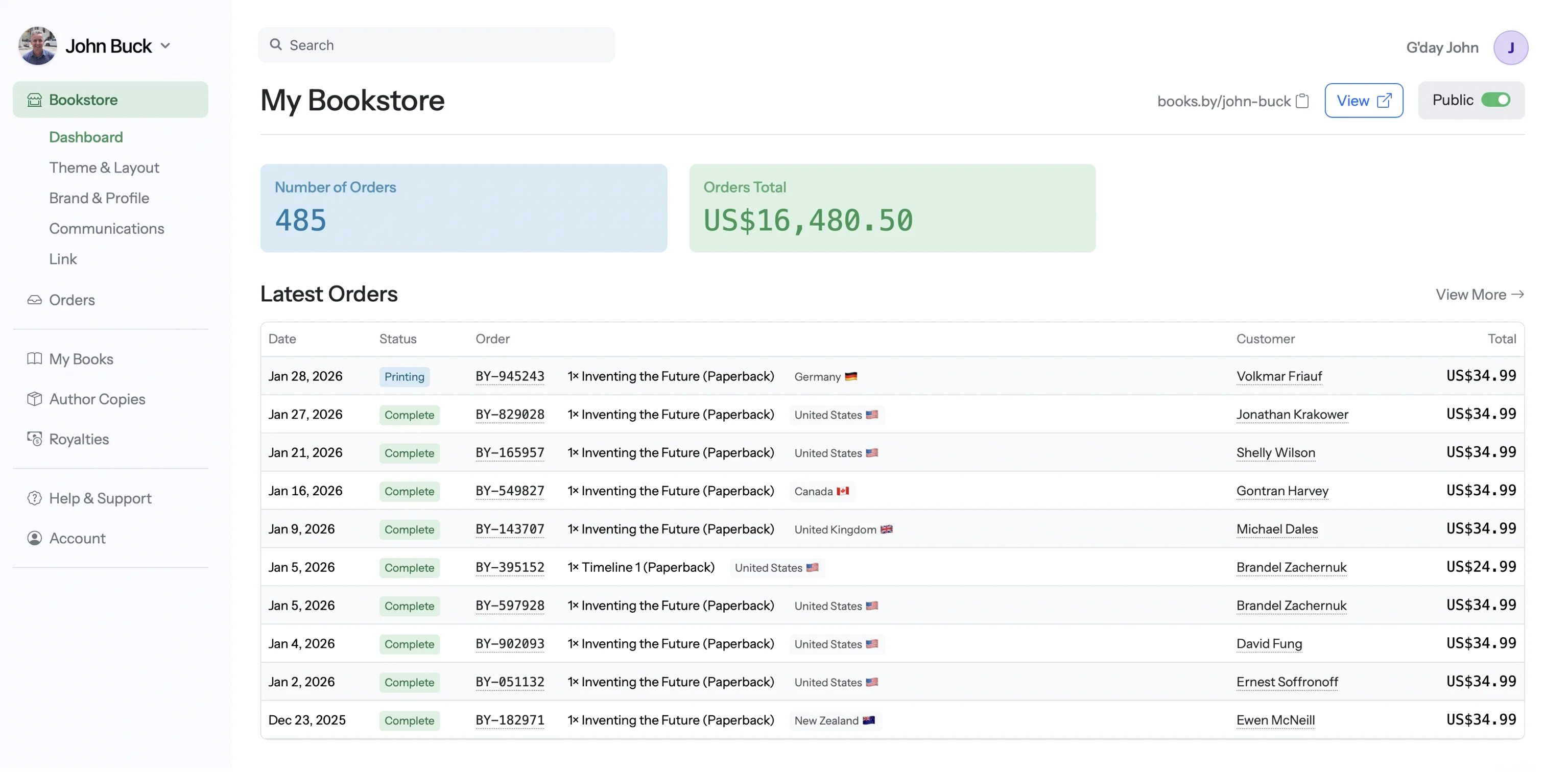
With Books.by, your organization gets a branded storefront at books.by/yourorgname. This becomes a permanent, professional presence for your publications.
What You Control
- Branding: Your logo, colors, and organizational messaging
- Pricing: Set any price — premium for fundraising or at-cost for accessibility
- Customer data: You receive buyer email addresses (unlike Amazon)
- Bundles: Offer program sets, donor packages, or classroom quantities
Integration with Your Website
Link to your Books.by storefront from your main website's shop or resources section. Embed purchase buttons in email campaigns. Include QR codes in printed materials that link directly to purchase pages.
Tax and Accounting Considerations
Consult your accountant, but here are the questions to ask:
Earned Income vs. Donations
Book sales are generally classified as earned income, not donations. This affects how you report on Form 990 and may have implications for your unrelated business income tax (UBIT) if the publishing activity is substantial.
Pricing for Tax Deductibility
If you want donors to receive tax deductions, structure book "sales" as donations with books as thank-you gifts. "Donate $50 and receive our book" is different from "Buy our book for $50." Your accountant can advise on proper structuring.
Expense Tracking
Track all publishing-related expenses — editing, design, photography, printing, shipping. These are legitimate organizational expenses that offset any UBIT liability.
Multi-Contributor Projects
Most nonprofit books involve multiple voices — staff, volunteers, board members, beneficiaries, community partners.
Coordination Strategies
- Assign one project lead: Someone needs to own deadlines, quality, and consistency
- Create clear submission guidelines: Word count, format, deadline, style requirements
- Use shared documents: Google Docs for collaborative editing with comment trails
- Build in buffer time: Volunteers are busy — double your expected timeline
Attribution Decisions
- Organization as author: "By [Your Nonprofit Name]"
- Editor credit: "Compiled and edited by [Name]"
- Individual attribution: Name each contributor at their section
- Anonymous: No individual names, just "Staff and Volunteers of [Organization]"
Common Nonprofit Publishing Mistakes
Mistake 1: Mission creep. Your book should serve one clear purpose. A fundraising book is different from an educational resource is different from a staff training manual. Pick one.
Mistake 2: Over-designing. Nonprofits often spend donor money on lavish design when simple and clean would work better. Your audience cares about content, not custom illustrations on every page.
Mistake 3: Underpricing. Don't price your book at $5 because you feel guilty charging for mission-related content. A properly priced $20 book that generates real funding serves more people than a $5 book that barely covers costs.
Mistake 4: Ignoring digital. Offer ebook versions for accessibility, international supporters, and those who prefer digital. Print-on-demand platforms like Books.by let you offer both formats.
Mistake 5: No distribution plan. The book won't sell itself. Who will promote it? Through what channels? To whom? Plan this before you publish, not after.
Frequently Asked Questions
Book sale proceeds are typically treated as earned income, not donations. However, if your organization is a registered 501(c)(3), you can direct 100% of book profits to your mission. Consult with your accountant about proper classification on your Form 990.
With Books.by's 100% royalty model, a 150-page book priced at $18 (printing cost ~$3.66) nets approximately $13.80 per sale after payment processing. Sell 500 copies and that's nearly $7,000 for your programs. Traditional publishers would take 40-60% of that.
Impact story collections, annual reports reimagined as books, cause-awareness guides, founder memoirs, program histories, and educational resources all work well. The key is matching the book to your donor/supporter base's interests.
Yes. Always obtain written consent before sharing anyone's story, especially for vulnerable populations. Use release forms that specify how the story will be used. Many nonprofits use composite characters or anonymized accounts to protect privacy while still illustrating impact.
Absolutely. Multi-contributor books are common for nonprofits — staff perspectives, volunteer stories, beneficiary testimonials, and board member insights. Designate one editor to maintain consistency in voice and formatting across all contributions.
With Books.by, order author copies at printing cost only — no markup. A 150-page B&W book costs approximately $3.66 per copy. Order 200 for your annual gala at $732 total, then include them as donor thank-you gifts or event centerpieces.
For internal distribution only, an ISBN isn't required. But for broader sales, library placement, or bookstore distribution, you'll want one. Books.by includes free ISBNs with your nonprofit listed as the publisher of record.