 Robes & Ledgers
Powered by Books.by
Robes & Ledgers
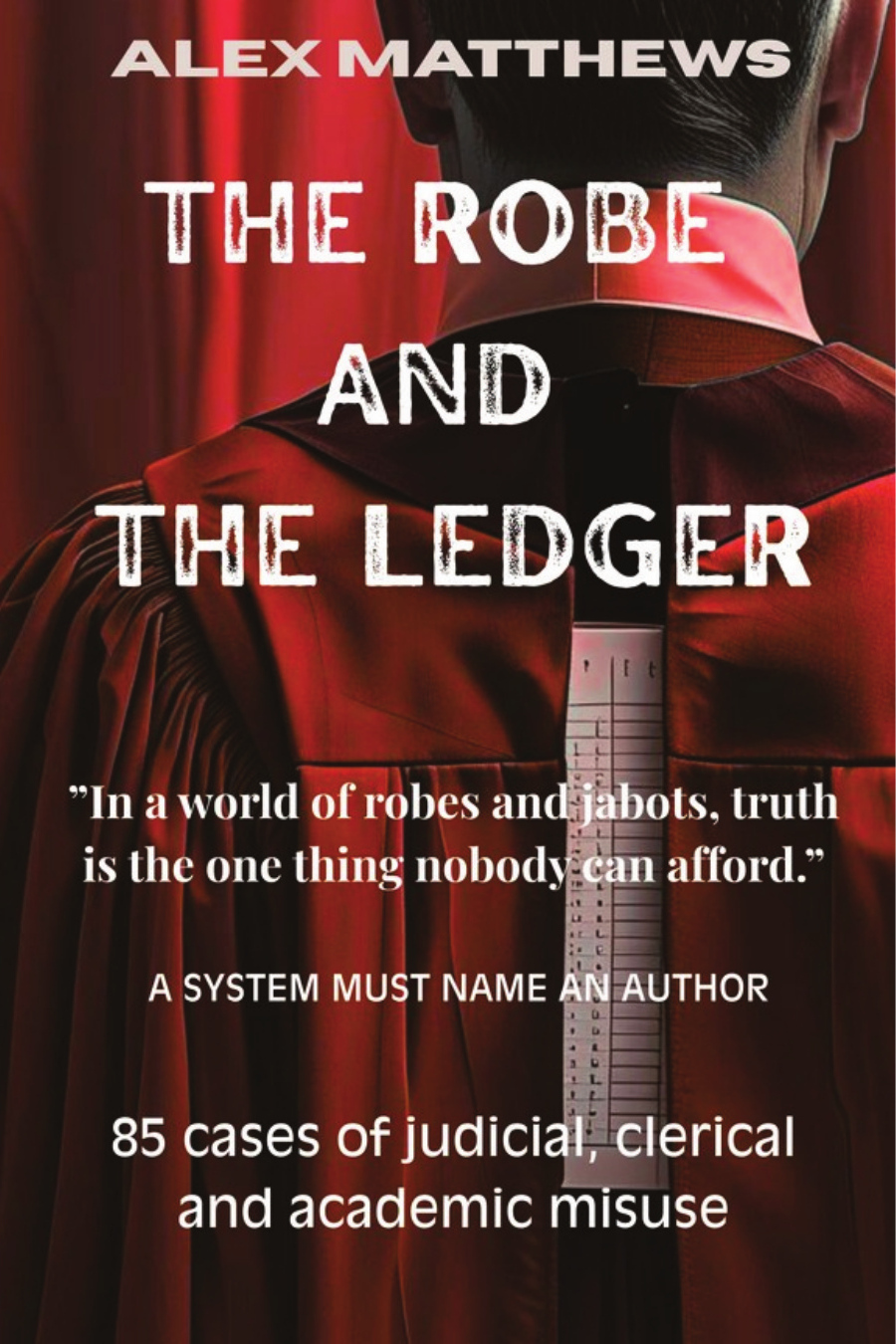
" In a world of Robes and Jabots, truth is the one thing nobody can afford."
by Alex Matthews
Based on true events. 85 cases of judicial, clerical and academic misuse. "The Robe and the Ledger" is for anyone who has ever felt ground down by a system they were told to trust. It speaks directly to whistleblowers, advocates, and survivors of institutional harm—but also to the people inside the machine: lawyers, academics, clergy, administrators, and managers who may not realize how easily “doing the process” becomes doing damage.
The Robe and the Ledger
Non-Fiction | Politics & Social Sciences | Institutional Critique & Policy Blueprint
What if the real danger in powerful institutions isn’t malice—but procedure?
"The Robe and the Ledger" is for anyone who has ever felt ground down by a system they were told to trust. It speaks directly to whistleblowers, advocates, and survivors of institutional harm—but also to the people inside the machine: lawyers, academics, clergy, administrators, and managers who may not realize how easily “doing the process” becomes doing damage.
Through a series of gripping, meticulously researched composite case studies spanning courts, churches, and universities, the book exposes a repeating pattern: when harm occurs, institutions often respond with prestige and paperwork, not responsibility. The language stays polished. The rituals remain intact. And accountability dissolves into committees, delays, and “insufficient information.”
But this is not just a diagnosis.
A tool for change: PRGR
At the heart of the book is the PRGR (Personal Reason-Giving Record)—a simple, scalable accountability system built on one radical principle:
Every harm must have a named author.
PRGR is not a theory or a slogan. It’s a practical technology for responsibility—designed to make the invisible mechanics of power visible, traceable, and reformable. In a world full of books that identify what’s broken, "The Robe and the Ledger" offers a concrete method for forcing institutions to own what they do.
Why this book stays with you
You don’t just read the pattern—you learn to see it. The book uses repetition as a deliberate rhetorical device, training your eye to recognize how harm repeats under different uniforms and vocabularies.
Genre-bending with purpose. Part investigative non-fiction, part institutional critique, part memoir, part practical user’s manual—its emotional core makes the analysis hit harder, and its policy blueprint makes the emotion useful.
Rigorous and unforgettably human. The systems are examined with clarity and discipline, but the stakes never become abstract: this is about real lives shaped by decisions nobody wants to “own.”
If you care about ethics, justice reform, institutional accountability—or you’ve ever wondered why the truth can be obvious and still go nowhere—"The Robe and the Ledger" will change how you recognize power.
And it will give you a way to challenge it.
““The robes speak when no one’s watching — and the truth is worse than you think. Read The Robe and the Ledger - ROBES, JABOTS and HUMAN FAILURE for eye-opening; impossible-to-ignore stories about power and silence.””
Brian Dryer, Human Rights Advocate
Written by someone who learned, firsthand, how institutions protect themselves—and built a tool to make them answer.
Born in the Netherlands, Alex Matthews began his working life in the classroom—as a primary school teacher—before turning to economics and later teaching at high school level, preparing adolescents for university and other higher education. He eventually left education to become a director of several companies. At forty, a serious car accident changed everything. Told he would never return to work; he refused to accept a protocol that didn’t match his ambitions. He enrolled in law and tax law, completing both within two and a half years. He practised as a lawyer and became a solicitor/barrister, tax lawyer, certified court mediator, chartered tax accountant, and arbitrator, moving within a highly engaged professional community in the legal world. Then his story turned. The comfortable assumptions behind institutions, such as how authority speaks, how harm hides, and how reputations are managed, became personal. This book begins at that hinge: where a life built on competence and trust meets the machinery that can undo both. Today, settled in Australia, Matthews is a well-known collector and photographer of minerals and runs a food business with his wife. Writing a book was never on his horizon. But horizons move—sometimes quietly, sometimes all at once—and this is the one he found himself compelled to cross.